是德科技 | KEYSIGHT
XA7系列N9042B 信号分析仪,2 Hz 至 26.5/44/50 GHz 详细指标
台式信号与频谱分析仪
| Frequency | option | Frequency | range |
|---|
| 526 | 2 Hz to 26.5 GHz | | |
| 544 | 2 Hz to 44 GHz | | |
| 550 | 2 Hz to 50 GHz | | |
| 575 | 2 Hz to 75 GHz | | |
Swept spectrum analysis (these bands are not applicable to wide-bandwidth IQ analysis)
Swept frequency band LO multiple (N) Frequency range 0 1 2 Hz to 3.6 GHz 1 1 3.5 to 8.4 GHz 2 2
8.3 to 13.6 GHz
条件:≤ (0.25 Hz x N) p-p in 20 ms nominal
Accuracy (total) ± [ (Initial accuracy) + (aging rate x time since last adjustment) + (temperature stability)]
Aging rate ± 3 x
10–8 / year
Temperature stability, full temperature range ± 4.5 x
10–9
Achievable initial calibration accuracy ± 3.1 x
10–8
Example frequency reference accuracy
1 year after last adjustment
= ± (3 ×10⁻⁸ + 4.5 ×10⁻⁹ + 3.1 x
10–8)
Residual FM (Center frequency = 1 GHz, 10 Hz RBW
10 Hz VBW)
(N = 本振倍频次数, 见频段 table above)
Frequency readout accuracy (start, stop, center, marker) ± (marker frequency x frequency reference accuracy + 0.10 % x span + 5 % x RBW + 2 Hz +
0.5 x horizontal resolution) where horizontal resolution is Span/(SweepPoints-1)
Accuracy ± (marker frequency x frequency reference accuracy +
0.100 Hz)
Delta counter accuracy ± (delta frequency x frequency reference accuracy +
0.141 Hz)
Counter resolution
0.001 Hz
Range 0 Hz (zero span)
10 Hz to maximum frequency of instrument
Stepped/Swept ± (0.1 % x span + horizontal resolution) where horizontal resolution is span/(sweep points
–1)
FFT ± (0.1 % x span + horizontal resolution) where horizontal resolution is span/(sweep points
–1)
Range Span = 0 Hz
1 μs to 6000 s
Span ≥ 10 Hz
1 ms to 4000 s
条件:Span ≥ 10 Hz, swept ± 0.01% nominal
Span ≥ 10 Hz, FFT ± 40% nominal
Span = 0 Hz
± 0.01% nominal
Span = 0 Hz or FFT
–150 to +500 ms
Span ≥ 10 Hz, swept
0 to 500 ms
Gate methods Gated LO; gated video; gated FFT
条件:Gate delay jitter 33.3 ns p-p nominal
Gate length range (except method = FFT)
1 μs to 5.0 s
Gate delay range
0 to 100.0 s
分辨率带宽 (RBW) (见 also IQ 分析 section)
Range (with –3 dB bandwidth, standard) 1 Hz to 3 MHz (10% steps), 4, 5, 6, 8
10 MHz
条件:RBW range Accuracy 1 Hz to 100 kHz ± 0.5% (± 0.022 dB) 110 kHz to 1.0 MHz (< 3.6 GHz center frequency) ± 1.0% (± 0.044 dB) 1.1 to 2 MHz (< 3.6 GHz center frequency) ± 0.07 dB (nominal)
2.2 to 3 MHz (< 3.6 GHz center frequency) ± 0.10 dB (nominal)
4 to 10 MHz (< 3.6 GHz center frequency) ± 0.20 dB (nominal)
RBW range Accuracy 1 Hz to 1.3 MHz ± 2% (nominal) 1.5 MHz to 3 MHz
• (≤ 3.6 GHz center frequency) ± 7% (nominal)
• (> 3.6 GHz center frequency) ± 8% (nominal)
• (≤ 3.6 GHz center frequency) ± 15% (nominal)
• (> 3.6 GHz center frequency) ± 20% (nominal)
Selectivity (-60 dB/-3 dB) 4.1: 1 (nominal)
Bandwidth accuracy (-3 dB)
4 MHz to 10 MHz
EMI bandwidths (CISPR
16-1-1; requires
N90EMEMCB or N6141EM0E) 200 Hz, 9 kHz, 120 kHz
1 MHz
EMI bandwidths (MIL-STD-461; requires
N90EMEMCB or N6141EM0E) 10 Hz, 100 Hz, 1 kHz, 10 kHz, 100 kHz
1 MHz
The preselector can have a significant passband ripple. To avoid ambiguous results, the
-4 dB bandwidth is characterized
Center frequency Mean bandwidth (-
4 dB)
Range 1 Hz to 3 MHz (10% steps), 4, 5, 6, 8 MHz, and wide open (labeled
50 MHz)
条件:With Option N90EMEMCB or N6141EM0E Add quasi-peak and EMI average to above
Normal, peak, sample, negative peak, log power average, RMS average, and voltage average
条件:External 1 Y Y Jitter up to ~33 ns p-p (nominal) External 2 Y Y
External 3 Y Jitter < 20 ps (nominal)
RF Burst Y Y IF path ≤
40 MHz only
Video (IF Mag) Y Y In 255 MHz IF path only; at greater bandwidths, ADC trigger is similar
ADC Y Similar to Video, but operates digitally on mag[I,Q], prior to decimation,
filtering, and corrections. Available for bandwidth >
255 MHz.
Periodic Y Y Y Repetitive “frame” trigger, at precise interval, following an External or
Minimum settable level
-170 dBm Useful range limited by noise
Highest allowed mixer level (the highest allowed mixer level depends
on the IF gain. It is nominally
–10 dBm for preamp off and IF gain =
检波器 = 正常, 峰值, Sample 或 Negative
Peak Triggers on the signal before detection, which is similar to the displayed signal
Detector = Average Triggers on the signal before detection, but with a single-pole filter added to give similar
smoothing to that of the average detector
Sweep Type = FFT Triggers on the signal envelope in a bandwidth wider than the FFT width
−40 to −10 dBm
Noise will limit trigger level range at high frequencies, such as above
15 GHz
条件:With positive slope trigger. Trigger level with negative slope is nominally 1 to 4 dB lower than positive slope.
Absolute ± 2 dB + absolute amplitude accuracy (nominal)
Bandwidth (-10 dB)
Most cases (including RF Burst Level Type = Relative)
> 80 MHz
If the start or center frequency is too close to zero, LO feedthrough can
degrade or prevent triggering. How close is too close depends on the
条件:made with preselector on (in circuit). These settings impact amplitude accuracy and range.
Amplitude characteristics vary by user-selectable front-end path. Swept SA measurements are normally
Default selection following power-on, boot-up, or PRESET. Settings provide best dynamic
range and lowest internally-generated distortion. Suitable for harmonics, IMD, spurious in
presence of large signals, etc. unless noise-limited.
1b Preselector, LNA on
Requires P26, P44, P4L, P50, or P5L. Settings provide lower DANL, compared to 1a, while
preserving very good dynamic range. Suitable for distortion measurements (harmonics, IMD,
etc.) when a lower noise floor is needed. Operates down to 10-20 MHz
1c Preselector, PA on Requires P26, P44, P4L, P50, or P5L. Settings provide lower DANL, compared to 1b. Allows
tuning down to 100 kHz.
1d Preselector, LNA
条件:RBW setting to achieve equivalent noise floors, so can make spur searching faster.
Requires P26, P44, P4L, P50, or P5L. Settings provide lowest possible DANL, compared to
1c. Best for finding low-level spurs, oscillations, etc. near the noise floor. Allows use of wider
2a
Bypasses the preamplifier. Settings provide the lowest distortion and best dynamic range,
yet with lower DANL at higher frequencies, when compared with 1a. Path not active below
3.6 GHz.
2b Preselector, LNP,
Bypasses the preamplifier. Requires P26, P44, P4L, P50, or P5L. Settings provide the lower
DANL, compared to 2a, while preserving very good dynamic range. Path not active at below
3.6 GHz.
3a
条件:low input power for below 3.6 GHz. Good for wideband digitizer and FFT measurements.
Bypasses preselector. Settings provide very good EVM floor at mid-high input power region
(using attenuation), including below
3.6 GHz. Good for wideband digitizer and FFT
measurements. Recommend using path 4a if above
3.6 GHz.
3b LNA on
Bypasses preselector. Requires P26, P44, P4L, P50, or P5L. Settings provide best EVM at
Otherwise use path 4b if above
3.6 GHz.
3c PA on
Bypasses preselector. Requires P26, P44, P4L, P50, or P5L. Good for wideband digitizer
and FFT measurements. Settings allowed only for very low power levels since preselector is
bypassed. Not generally recommended for digital demodulation.
3d LNA on, PA on
Bypasses preselector. Requires P26, P44, P4L, P50, or P5L. Good sensitivity for
narrowband swept measurements only. Not generally recommended for digital
条件:provide best EVM floor for low input power region (using attenuation) for above 3.6 GHz.
Bypasses both preamplifier and preselector. Settings provide best EVM floor for mid-high
input power region (using attenuation) for above
3.6 GHz. Best for wideband digitizer and
FFT measurements. Otherwise use path 3a if below
3.6 GHz.
4b LNP, MPB, LNA on
Bypasses both preamplifier and preselector. Requires P26, P44, P4L, P50, or P5L. Settings
Best for wideband digitizer and FFT measurements. Otherwise use path
3b if below
3.6 GHz.
Displayed average noise level (DANL) to +30 dBm (for preamp off)
DANL to +24 dBm (for frequency opts ≤
526 with preamp on)
DANL to +20 dBm (for frequency opts >
526 with preamp on)
Input mechanical attenuator range (2 Hz to 50 GHz)
0 to 70 dB in 2 dB steps
Electronic attenuator (option EA3)
Frequency range
2 Hz to 3.6 GHz (option EA3)
Electronic attenuator range 0 to 24 dB
1 dB steps (option EA3)
0 to 26 dB, 2 dB steps (option 575
50 – 75 GHz)
Full attenuation range (mechanical + electronic) 0 to 94 dB
1 dB steps (option EA3)
最大安全输入电平 (最大 applied 至 RF 输入连接器)
Average total power (with and without preamp) 2 Hz to 50 GHz
+30 dBm (1 W)
+20 dBm (100 mW), full bypass path
50 to 75 GHz
+18 dBm (63 mW)
Peak pulse power (< 10 μs pulse width, < 1% duty cycle, and input attenuation ≥ 30 dB) 2 Hz to 50 GHz +50 dBm (100 W) 50 to 75 GHz
+18 dBm (63 mW)
DC Bias at RF Input
0 VDC max (DC coupled) Use external DC block as
needed
0.2 VDC max in full bypass path
DC coupled
± 0.2 Vdc (2 – 50 GHz)
0 Vdc (50 – 75 GHz)
Log scale
0.1 to 1 dB/division in 0.1 dB steps
1 to 20 dB/division in 1 dB steps (10 display)
Scale units dBm, dBmV, dBμV, dBmA, dBμA, V, W, A
条件:Frequency Response 1a. Standard path frequency response (swept, preselector on, LNA off, PA off) 10 dB input attenuation, preselector centering applied above 3.6 GHz, ≤ 50 GHz relative to 50 MHz reference conditions, > 50 GHz as absolute amplitude accuracy
Frequency Full range
20 to 30 °C Typical, unless stated otherwise
9 kHz to 20 MHz ± 0.54 dB ± 0.50 dB
± 0.15 dB
> 20 MHz to 50 MHz ± 0.44 dB ± 0.40 dB
± 0.12 dB
> 50 MHz to 3.6 GHz ± 0.58 dB ± 0.52 dB
± 0.22 dB
> 3.6 to 5.2 GHz ± 2.70 dB ± 1.90 dB
± 0.98 dB
> 5.2 GHz to 8.4 GHz ± 2.50 dB ± 1.40 dB
± 0.58 dB
> 8.4 to 13.6 GHz ± 2.00 dB ± 1.50 dB
± 0.54 dB
> 13.6 to 17.1 GHz ± 2.00 dB ± 1.70 dB
± 0.68 dB
> 17.1 to 26.5 GHz ± 2.32 dB ± 1.90 dB
± 0.74 dB
> 26.5 to 34.5 GHz ± 2.70 dB ± 2.30 dB
± 0.94 dB
> 34.5 to 50 GHz ± 4.35 dB ± 3.00 dB
± 1.22 dB
> 50.0 to 70.0 GHz N/A ± 4.00 dB
± 2.50 dB
> 70.0 to 75.0 GHz N/A ± 5.00 dB
± 3.00 dB
条件:10 dB input attenuation, relative to reference conditions (50 MHz), preselector centering applied above 3.6 GHz
10 dB input attenuation, relative to reference conditions (50 MHz), preselector centering applied above 3.6 GHz
10 dB input attenuation, relative to reference conditions (50 MHz), preselector centering applied above 3.6 GHz
10 dB input attenuation, relative to reference conditions (50 MHz), preselector centering applied above 3.6 GHz
10 dB input attenuation, relative to reference conditions (50 MHz), preselector centering applied above 3.6 GHz
Frequency Frequency response (nominal) 3.6 to 8.4 GHz ± 0.80 dB
10 dB input attenuation, ≤ 50 GHz relative to 50 MHz reference conditions, > 50 GHz as absolute amplitude accuracy
(nominal) 3c. MPB, PA on (10 dB input attenuation) (nominal)
(nominal) 3.6 GHz to 8.4 GHz ± 0.40 dB ± 0.30 dB ± 0.40 dB
(10 dB input attenuation) (nominal)
(10 dB input attenuation) (nominal)
Electronic attenuator frequency response (10 dB mechanical input attenuation, relative to reference conditions (50 MHz)
Maximum error relative to reference conditions (50 MHz). Mechanical attenuation set to default/calibrated setting of 10 dB.
Attenuation 0 dB ± 0.05 dB (nominal)
Attenuation >2 dB at other frequencies (nominal)
Path Full range 20 to 30 °C Typical AutoAlign = Light, nominal
For absolute amplitude accuracy at any frequency in the 1a. Std Path, use the following formulas:
Attenuation = 0 to 26 dB
2 dB steps
> 50.0 to 75.0 GHz N/A N/A
± 1.50 dB (nom.)
1b. Standard path, LNA on frequency response (swept, preselector on, LNA on, PA off)
Frequency Full range
20 to 30 °C Typical, unless stated otherwise
30 MHz to 3.6 GHz ± 0.68 dB ± 0.54 dB
± 0.25 dB
> 3.6 to 5.2 GHz ± 2.90 dB ± 2.28 dB
± 1.14 dB
> 5.2 to 8.4 GHz ± 2.80 dB ± 2.06 dB
± 0.98 dB
> 8.4 to 13.6 GHz ± 2.40 dB ± 2.02 dB
± 0.88 dB
> 13.6 to 17.1 GHz ± 2.40 dB ± 2.16 dB
± 0.88 dB
> 17.1 to 26.5 GHz ± 2.86 dB ± 2.42 dB
± 0.98 dB
> 26.5 to 34.5 GHz ± 3.10 dB ± 2.60 dB
± 1.18 dB
> 34.5 to 50 GHz ± 5.25 dB ± 4.30 dB
± 2.04 dB
1c. Standard path, PA on frequency response (swept, preselector on, LNA off, PA on)
Frequency Full range
20 to 30 °C Typical, unless stated otherwise
9 kHz to 1 MHz N/A N/A
± 0.82 dB
> 1 to 50 MHz ± 0.80 dB ± 0.78 dB
± 0.25 dB
> 50 MHz to 3.6 GHz ± 0.68 dB ± 0.50 dB
± 0.18 dB
> 3.6 to 5.2 GHz ± 2.80 dB ± 2.30 dB
± 1.20 dB
> 5.2 GHz to 8.4 GHz ± 2.60 dB ± 1.64 dB
± 0.64 dB
> 8.4 to 13.6 GHz ± 2.30 dB ± 1.80 dB
± 0.60 dB
> 13.6 to 17.1 GHz ± 2.30 dB ± 2.00 dB
± 0.70 dB
> 17.1 to 26.5 GHz ± 2.86 dB ± 2.22 dB
± 0.72 dB
> 26.5 to 34.5 GHz ± 3.10 dB ± 2.44 dB
± 1.02 dB
> 34.5 to 50 GHz ± 5.06 dB ± 3.85 dB
± 1.78 dB
1d. Standard path, LNA on, PA on frequency response (swept, preselector on, LNA on, PA on)
Frequency Full range
20 to 30 °C Typical, unless stated otherwise
< 3.6 GHz If tuning <
3.6 GHz, then standard path with LNA on is used.
3.6 GHz to 8.4 GHz ± 3.00 dB ± 2.50 dB
± 1.36 dB
> 8.4 to 13.6 GHz ± 2.50 dB ± 2.20 dB
± 0.96 dB
> 13.6 to 17.1 GHz ± 2.30 dB ± 2.20 dB
± 0.94 dB
> 17.1 to 26.5 GHz ± 2.85 dB ± 2.40 dB
± 1.00 dB
> 26.5 to 34.5 GHz ± 3.20 dB ± 2.80 dB
± 1.32 dB
> 34.5 to 50 GHz ± 5.30 dB ± 4.50 dB
± 2.26 dB
2a. Low-noise path (LNP) frequency response (low-noise path enabled, preselector on, LNA off, PA off)
Frequency Full range
20 to 30 °C Typical, unless stated otherwise
3.6 GHz to 8.4 GHz ± 3.10 dB ± 2.30 dB
± 1.00 dB
> 8.4 to 13.6 GHz ± 2.12 dB ± 1.72 dB
± 0.56 dB
> 13.6 to 17.1 GHz ± 2.00 dB ± 1.78 dB
± 0.66 dB
> 17.1 to 26.5 GHz ± 2.52 dB ± 1.92 dB
± 0.64 dB
> 26.5 to 34.5 GHz ± 2.80 dB ± 2.45 dB
± 0.94 dB
> 34.5 to 50 GHz ± 3.58 dB ± 2.84 dB
± 1.20 dB
2b. Low-noise path (LNP) frequency response (low-noise path enabled, preselector on, LNA on, PA off)
˃ 8.4 to 13.6 GHz
± 0.70 dB
˃ 13.6 to 17.1 GHz
± 0.70 dB
˃ 17.1 to 26.5 GHz
± 0.70 dB
˃ 26.5 to 34.5 GHz
± 1.00 dB
˃ 34.5 to 50 GHz
± 1.40 dB
3a. Microwave preselector bypass (MPB) path frequency response (MPB enabled, LNA off, PA off)
Frequency Full range
20 to 30 °C Typical, unless stated
otherwise 3.6 GHz to 8.4 GHz ± 1.50 dB ± 1.44 dB
± 0.40 dB
> 8.4 to 13.6 GHz ± 1.66 dB ± 1.50 dB
± 0.50 dB
> 13.6 to 17.1 GHz ± 2.00 dB ± 1.62 dB
± 0.56 dB
> 17.1 to 26.5 GHz ± 2.52 dB ± 1.80 dB
± 0.56 dB
> 26.5 to 34.5 GHz ± 2.55 dB ± 2.10 dB
± 0.78 dB
> 34.5 to 50 GHz ± 4.20 dB ± 2.90 dB
± 1.12 dB
> 50.0 to 70.0 GHz N/A ± 4.00 dB
± 2.50 dB
> 70.0 to 75.0 GHz N/A ± 5.00 dB
± 3.00 dB
Software Preselection ON Attenuation = 0 to 26 dB
2 dB steps
> 50.0 to 75.0 GHz N/A N/A
± 1.50 dB (nom.)
3b, 3c
3d. Microwave preselector bypass (MPB) path frequency response (MPB path enabled)
3b. MPB, LNA on
(10 dB input attenuation)
3d. MPB, LNA on, PA on
(10 dB input attenuation)
> 8.4 to 13.6 GHz ± 0.50 dB ± 0.30 dB
± 0.45 dB
> 13.6 to 17.1 GHz ± 0.50 dB ± 0.40 dB
± 0.45 dB
> 17.1 to 26.5 GHz ± 0.50 dB ± 0.40 dB
± 0.50 dB
> 26.5 to 34.5 GHz ± 0.50 dB ± 0.50 dB
± 0.60 dB
> 34.5 to 50 GHz ± 0.90 dB ± 1.20 dB
± 1.00 dB
4a
4b. Full bypass (FBP) path frequency response (full bypass path enabled)
4a. FBP
4b. FBP, LNA on
3.6 GHz to 8.4 GHz ± 0.20 dB
± 0.30 dB
> 8.4 to 13.6 GHz ± 0.25 dB
± 0.50 dB
> 13.6 to 17.1 GHz ± 0.30 dB
± 0.50 dB
> 17.1 to 26.5 GHz ± 0.30 dB
± 0.50 dB
> 26.5 to 34.5 GHz ± 0.40 dB
± 0.50 dB
> 34.5 to 50 GHz ± 0.60 dB
± 1.00 dB
EA3 frequency Full range
20 to 30 °C Typical, unless stated otherwise
Attenuation =
4 to 24 dB, even steps
9 kHz to 50 MHz ± 0.80 dB ± 0.65 dB
± 0.18 dB
50 MHz to 3.6 GHz ± 0.50 dB ± 0.48 dB
± 0.22 dB
Attenuation = 0,1,2 and odd steps
3 to 23 dB
10 MHz to 3.6 GHz N/A N/A
± 0.22 dB
Attenuator switching uncertainty (50 MHz reference frequency, relative to 10 dB reference setting, LNA off, PA off)
1a. Std (10 dB input attenuation)
Attenuation 12 to 40 dB
± 0.14 dB
± 0.04 dB (typical)
Attenuation 2 to 8 dB, or > 40 dB
± 0.18 dB
± 0.06 dB (typical)
> 3.6 to 8.4 GHz
± 0.5 dB
> 8.4 to 26.5 GHz
± 0.7 dB
> 26.5 to 50 GHz
± 1.0 dB
Total absolute amplitude accuracy (at
50 MHz)
At 50 MHz, 10 dB attenuation, RBW ≤ 1 MHz, input signal -10 to -50 dBm, for Path 1a or -40 to -70 dBm for Path
1b and 1c, all settings auto-coupled except Auto
Sweep Time = Accuracy, any reference revel, any vertical scale.
1a. Std ± 0.34 dB ± 0.32 dB ± 0.12 dB
± 0.18 dB
1b. Std (LNA on, preamp off) ± 0.44 dB ± 0.40 dB ± 0.16 dB
± 0.19 dB
1c. Std (LNA off, preamp on) ± 0.42 dB ± 0.38 dB ± 0.12 dB
± 0.17 dB
With electronic attenuator (at 50 MHz, 10 dB attenuation, RBW < = 1 MHz, input signal -7 to -25 dBm, all settings auto-coupled except Auto Sweep Time = Accuracy, any reference level, any vertical scale) 1a. Std ± 0.37 dB ± 0.32 dB ± 0.12 dB
± 0.17 dB
At any frequency ≤
50 GHz ± (abs amp at 50 MHz + frequency response)
At any frequency >
50 GHz Refer to Frequency Response
Wide range of signal levels, resolution bandwidths, reference levels, attenuation = 10 dB
10 Hz to 3.6 GHz
Note1: Absolute amplitude accuracy is the total of all amplitude measurement errors, and applies over the following subset of settings and
条件:• Span < 5 MHz (nominal additional error for span ≥ 5 MHz is is 0.02 dB)
• Input signal
−10 to −50 dBm (details below)
• 全部设置 auto-耦合 except Swp 时间 Rules = 精度
条件:This absolute amplitude accuracy specification includes the sum of the following individual specifications under the conditions listed above: Scale
confidence. Here are the details of what is covered and how the computation is made:
• The wide range of conditions of RBW, signal level, VBW, reference level and display scale are described above.
• There are 44 quasi-random combinations used, tested at a 50 MHz signal frequency.
• We compute the 95th percentile proportion with 95% confidence for this set observed over a statistically significant number of instruments.
verification frequencies that are chosen to not correspond with the frequency response adjustment frequencies.
• We again compute the 95th percentile proportion with 95% confidence for this set observed over a statistically significant number of instruments.
• Combinations of low signal level and wide RBW use VBW ≤
30 kHz to reduce noise
• When using FFT sweeps, the signal must be at the center frequency.
Fidelity, Reference Level Accuracy, Display Scale Switching Uncertainty, Resolution Bandwidth Switching Uncertainty
50 MHz Amplitude
Reference Accuracy, and the accuracy with which the instrument aligns its internal gains to the
50 MHz Amplitude Reference. The only difference
between signals within the range above
–50 dBm and those signals below that level is the scale fidelity. Our specifications and experience show no
difference between signals above and below this level. The only reason our Absolute Amplitude Uncertainty specification does not go below this
level is that noise detracts from our ability to verify the performance at all levels with acceptable test times and yields. So, the performance is not
warranted at lower levels, but we fully expect it to be the same.
Note 2: Absolute amplitude accuracy for a wide range of signal and measurement settings, covers the
95th percentile proportion with 95%
• Also, the frequency response relative to the
50 MHz response is characterized by varying the signal across a large number of quasi-random
• We also compute the 95th percentile accuracy of tracing the calibration of the
50 MHz absolute amplitude accuracy to a national standards
条件:• To that RSS we add the environmental effects of temperature variations across the 20 to 30°C range.
• These computations and measurements are made with the mechanical attenuator only in circuit, set to the reference state of 10 dB.
through 24 dB inclusive, with the mechanical attenuator set to 10 dB. The 95th percentile result was 0.21 dB.
Standard path, 10 dB input attenuation, 50 MHz (reference condition) 1.07:1 (nominal)
Standard path, 0 dB input attenuation, 0.01 to 3.6 GHz 2.2:1 (nominal)
LNP operation, and between FBP and non-FBP operation, but the details, such as the frequencies of the peaks and valleys, will shift.
Standard path, 10 dB input attenuation, 50 MHz (reference condition) 1.07:1 (nominal)
Standard path, 0 dB input attenuation, 0.01 to 3.6 GHz 2.2:1 (nominal)
LNP operation, and between FBP and non-FBP operation, but the details, such as the frequencies of the peaks and valleys, will shift.
• We also compute the
95th percentile accuracy of tracing the calibration of the relative frequency response to a national standards organization
• We take the root-sum-square of these four independent Gaussian parameters
A similar process is used for computing the result when using the electronic attenuator under a wide range of settings: all even settings from 4
VSWR (voltage standing wave ratio) at RF Input (95th percentile) (Options 526, 544
550)
Center frequency 1a. Std, IF path ≤
40 MHz
(10 dB input attenuation)
1b. Std, LNA on and
1d. Std, LNA on, PA on
(0 dB input attenuation)
1c. Std, PA on
(0 dB input attenuation)
10 MHz to 3.6 GHz 1.18 1.23 (path 1b. only)
1.66
> 3.6 to 8.4 GHz 1.20 1.39
1.57
> 8.4 to 13.6 GHz 1.20 1.28
1.42
> 13.6 to 17.1 GHz 1.28 1.38
1.39
> 17.1 to 26.5 GHz 1.32 1.36
1.40
> 26.5 to 34.5 GHz 1.50 1.60
1.63
> 34.5 to 50 GHz 1.65 1.73
1.79
Center frequency 3a. MPB, IF path ≥
255 MHz (10 dB input attenuation)
The magnitude of the mismatch over the range of frequencies will be very similar between MPB and non-MPB operation, between LNP and non-
VSWR (voltage standing wave ratio) at RF Input (95th percentile) (Option
575)
Center frequency 1a. Std, IF path ≤
40 MHz
(10 dB input attenuation)
1b. Std, LNA on and
1d. Std, LNA on, PA on
(0 dB input attenuation)
1c. Std, PA on
(0 dB input attenuation)
10 MHz to 3.6 GHz 1.21 1.24 (path 1b. only)
1.65
> 3.6 to 8.4 GHz 1.24 1.36
1.52
> 8.4 to 13.6 GHz 1.33 1.37
1.49
> 13.6 to 17.1 GHz 1.41 1.46
1.49
> 17.1 to 26.5 GHz 1.39 1.43
1.42
> 26.5 to 34.5 GHz 1.40 1.48
1.48
> 34.5 to 50 GHz 1.66 1.71
1.68
> 50 to 75 GHz
2.16 N/A N/A
Center frequency 3a. MPB, IF path ≥
255 MHz (10 dB input attenuation)
The magnitude of the mismatch over the range of frequencies will be very similar between MPB and non-MPB operation, between LNP and non-
VSWR plots (Options 526, 544
550)
Figure 1. VSWR vs. frequency (0 to 3.5 GHz), 1a. Standard Path, 10 dB attenuation, measured on
3 units
Figure 2. VSWR vs. frequency (3.5 to 26 GHz), 1a. Standard Path, 10 dB attenuation, measured on
3 units
Figure 3. VSWR vs. frequency (26 to 50 GHz), 1a. standard path, 10 dB attenuation, measured on
3 units
Figure 4. VSWR vs. frequency (0 to 3.5 GHz), 1c. preamp on, 0 dB attenuation, measured on
3 units
Figure 5. VSWR vs. frequency (3.5 to 26 GHz), 1c. preamp on, 0 dB attenuation, measured on
3 units
Figure 6. VSWR vs. frequency (26 to 50 GHz), 1c. preamp on, 0 dB attenuation, measured on
3 units
Figure 7. VSWR vs. frequency (0 to 3.5 GHz), 1a. Standard Path, 10 dB attenuation, measured on
3 units
Figure 8. VSWR vs. frequency (3.5 to 26 GHz), 1a. Standard Path, 10 dB attenuation, measured on
3 units
Figure 9. VSWR vs. frequency (26 to 50 GHz), 1a. standard path, 10 dB attenuation, measured on
3 units
Figure 10. VSWR vs. frequency (50 to 75 GHz), 1a. standard path, 10 dB attenuation, measured on
3 units
Figure 11. VSWR vs. frequency (0 to 3.5 GHz), 1c. preamp on, 0 dB attenuation, measured on
3 units
Figure 12. VSWR vs. frequency (3.5 to 26 GHz), 1c. preamp on, 0 dB attenuation, measured on
3 units
Figure 13. VSWR vs. frequency (26 to 50 GHz), 1c. preamp on, 0 dB attenuation, measured on
3 units
Resolution bandwidth switching uncertainty (relative to 30 kHz RBW)
1 Hz to 1.5 MHz RBW <
± 0.03 dB
1.6 MHz to 2.7 MHz RBW <
± 0.05 dB
4, 5, 6, 8, 10 MHz RBW
± 0.3 dB
Log scale
–170 to +30 dBm in 0.01 dB steps
Linear scale
707 pV to 7.07 V with 0.11% (0.01 dB) resolution
Accuracy (Only affects the display, not the measurement, so it
causes no additional error in measurement results from trace data or
条件:Display scale fidelity (log-linear fidelity, relative to the reference condition -25 dBm input thrqough 10 dB attenuation, thus -35
Switching between linear and log (Only affects the display, not the
measurement, so it causes no additional error in measurement results from trace data or markers.)
0 dB
Log scale/div switching (Only affects the display, not the measurement, so it causes no additional error in measurement results from trace data or markers.)
0 dB
-18 dBm ≤ ML ≤ -10 dBm ± 0.10 dB total
± 0.04 dB
ML < -18 dBm input mixer level ± 0.07 dB
± 0.02 dB
Preamplifiers (2 stages: Low-Noise Amplifier LNA, Pre-Amplifier PA)
Low-Noise Amplifier (LNA) Pre-Amplifier (PA)
条件:Noise figure 4 to 8 dB (nominal) (see DANL) 10 dB (nominal)
Gain 20 dB (nominal) 30 dB (nominal)
When LNA and PA are used simultaneously, gain = 40 dB (nominal)
Option P44, P4L 20 MHz to 44 GHz
9 kHz to 44 GHz
Option P50, P5L 20 MHz to 50 GHz
9 kHz to 50 GHz
For options P4L/P5L: ≥
43.5 GHz both LNA and PA cannot be used simultaneously
1 dB Gain compression
条件:interfering signal must be in order to cause a 1 dB change in an on-screen signal.
• Large signals, even at frequencies not shown on the screen, can cause the analyzer to mismeasure
on-screen signals because of two-tone gain compression. This specification tells how large an
• Specified at 1 kHz RBW with 100 kHz tone spacing. The compression point will nominally equal the
specification for tone spacing greater than
5 times the prefilter bandwidth. At smaller spacings, ADC
clipping may occur at a level lower than the
1 dB compression point.
• Reference level and off-screen performance: The reference level (RL) behavior differs from some
earlier analyzers in a way that makes this analyzer more flexible. In other analyzers, the RL
controlled how the measurement was performed as well as how it was displayed. Because the
logarithmic amplifier in these analyzers had both range and resolution limitations, this behavior was
necessary for optimum measurement accuracy. The logarithmic amplifier in this signal analyzer,
however, is implemented digitally such that the range and resolution greatly exceed other
instrument limitations. Because of this, the analyzer can make measurements largely independent
of the setting of the RL without compromising accuracy. Because the RL becomes a display
function, not a measurement function, a marker can read out results that are off-screen, either
above or below, without any change in accuracy. The only exception to the independence of RL and
the way in which the measurement is performed is in the input attenuation setting: When the input
attenuation is set to auto, the rules for the determination of the input attenuation include
dependence on the reference level. Because the input attenuation setting controls the tradeoff
between large signal behaviors (third-order intermodulation, compression, and display scale fidelity)
and small signal effects (noise), the measurement results can change with RL changes when the
条件:• Mixer power level (dBm) = total power at the input (dBm) − input attenuation (dB).
• Total power at the preamp (dBm) = total power at the input (dBm) − input attenuation (dB).
• The low noise path, when in use, does not substantially change the compression-to-noise dynamic
range or the TOI-to-noise dynamic range because it mostly just reduces losses in the signal path in
front of all significant noise, TOI and compression-affecting circuits. In other words, the compression
threshold and the third-order intercept both decrease and to the same extent as that to which the
Standard path
1 dB gain compression (swept, standard, preselector on)
条件:Gain compression (nominal) 1a. PA off 1b. LNA 1c. PA 1d. LNA PA 20 to 40 MHz +2 dBm -14 dBm -14 dBm -14 dBm
> 40 MHz to 3.6 GHz +5 dBm -14 dBm -14 dBm
-14 dBm
> 3.6 to 13.5 GHz +8 dBm -14 dBm -22 dBm
-28 dBm
> 13.5 to 26.5 GHz +3 dBm -14 dBm -24 dBm
-32 dBm
> 26.5 to 50 GHz +6 dBm -10 dBm -23 dBm
-33 dBm
Low-Noise Path (LNP)
1 dB gain compression (swept, LNP, preselector on)
Large signals, even at frequencies not shown on the screen, can cause the analyzer to mismeasure on-screen signals because of two-tone gain
compression. This specification tells how large an interfering signal must be in order to cause a
1 dB change in an on-screen signal. Mixer power
level (dBm) = total power at the input (dBm) − input attenuation (dB).
条件:Gain compression (nominal) 2a. Preselector LNP 2b. Preselector LNP LNA
> 3.6 to 13.5 GHz +2 dBm
-14 dBm
> 13.5 to 26.5 GHz +0 dBm
-18 dBm
>26.5 to 50 GHz +3 dBm
-16 dBm
Microwave preselector bypass path (MPB)
1 dB gain compression ( swept, preselector bypass)
Large signals, even at frequencies not shown on the screen, can cause the analyzer to mismeasure on-screen signals because of two-tone gain
compression. This specification tells how large an interfering signal must be in order to cause a
1 dB change in an on-screen signal. Mixer power
level (dBm) = total power at the input (dBm) − input attenuation (dB).
条件:Gain compression (nominal) 3a. MPB 3b. MPB LNA 20 to 40 MHz +2 dBm -14 dBm
> 40 MHz to 3.6 GHz +5 dBm
-14 dBm
> 3.6 to 13.5 GHz +2 dBm
-17 dBm
> 13.5 to 26.5 GHz +0 dBm
-17 dBm
>26.5 to 50 GHz +0 dBm
-15 dBm
Full bypass path (FBP)
1 dB gain compression ( swept, full bypass)
Large signals, even at frequencies not shown on the screen, can cause the analyzer to mismeasure on-screen signals because of two-tone gain
compression. This specification tells how large an interfering signal must be in order to cause a
1 dB change in an on-screen signal. Mixer power
level (dBm) = total power at the input (dBm) − input attenuation (dB).
条件:Gain compression (nominal) 4a. FBP 4b. FBP LNA
> 3.6 to 13.5 GHz -4 dBm
-20 dBm
> 13.5 to 26.5 GHz -5 dBm
-23 dBm
>26.5 to 50 GHz -5 dBm
-22 dBm
条件:This table applies without Option FS1 or FS2, fast sweep. With Option FS1 or FS2, which is a standard option in the UXA, this table applies for
Zero span or swept, RBW= Sweep type = FFT, FFT width = –3 dB bandwidth (nominal)
sweep rates that are manually chosen to be the same as or slower than "traditional" sweep rates, instead of the much faster sweep rates, such as
auto-coupled sweep rates, available with FS1 or FS2. Sweep rate is defined to be span divided by sweep time. If the sweep rate is ≤
1.1 times RBW-
squared, the table applies. Otherwise, compute an "effective RBW" = span / (sweeptime × RBW). To determine the IF Prefilter bandwidth, look up
this effective RBW in the table instead of the actual RBW. For example, for RBW = 3 kHz, Span = 300 kHz, and sweep time =
42 ms, we compute
that sweep rate = 7.1 MHz/s, while RBW-squared is 9 MHz/s. So, the sweep rate is < 1.1 times RBW-squared and the table applies; row
1 shows the
IF prefilter bandwidth is nominally 8.9 kHz. If the sweep time is
1 ms, then the effective RBW computes to 100 kHz. This would result in an IF
prefilter bandwidth from the third row, nominally
303 kHz
≤ 3.9 kHz < 4.01 kHz
8.9 kHz
4.3 to 27 kHz < 28.81 kHz
79 kHz
30 to 160 kHz < 167.4 kHz
303 kHz
180 to 390 kHz < 411.9 kHz
966 kHz
430 kHz to 10 MHz < 7.99 MHz
10.9 MHz
条件:Noise Floor Extension (Option NF2) improves DANL by 8 to 11 dB, for standard path.
Frequency Full range 20 to 30 °C Typical, unless otherwise stated
Input terminated, Sample or Average detector, Averaging type set to Log, IF Gain = High
1 Hz Resolution
Bandwidth
0 dB input attenuation.
1a. Standard path DANL (swept, preselector on, LNA off, PA off)
For 50 – 75 GHz, Noise Floor Extension (Option NF2) improves DANL by
3 to 5 dB, for standard path
2 to 10 Hz
条件:> 10 to 100 Hz -115 dBm (nominal)
> 100 Hz to 1 kHz -128 dBm (nominal)
> 1 to 9 kHz -138 dBm (nominal)
Frequency Full range 20 to 30 °C Typical, unless otherwise stated
Noise Floor Extension (Option NF2) improves DANL by 7 to 9 dB, for standard path, PA on.
Frequency Full range 20 to 30 °C Typical, unless otherwise stated
Noise Floor Extension (Option NF2) improves DANL by 9 to 10 dB, for standard path, LNA on, PA on.
Frequency Full range 20 to 30 °C Typical, unless otherwise stated
> 43.5 to 47 GHz (for option P44
> 43.5 to 47 GHz (for option P50
> 47 to 50 GHz (for option P50) -150 dBm -152 dBm -158 dBm
> 43.5 to 47 GHz (for option P4L
> 43.5 to 47 GHz (for option P5L
> 47 to 50 GHz (for option P5L)
Noise Floor Extension (Option NF2) improves DANL by 9 to 11 dB, for low-noise path.
Frequency Full range 20 to 30 °C Typical, unless otherwise stated
Frequency 2b. LNP path, LNA on (nominal)
Frequency 3a. MPB path (nominal) 3b. MPB, LNA on (nominal)
If using microwave preselector bypass path (MPB) use path 3b for digital demodulation.
Frequency Full range 20 to 30 °C Typical, unless otherwise stated
4b. Full bypass (FBP) path DANL (low-noise path enable, preselector bypass on, LNA on) (nominal)
-90 dBm (nominal)
> 9 to 100 kHz -138 dBm -140 dBm -146 dBm, -144 dBm (Option
575)
> 100 kHz to 1 MHz -151 dBm -152 dBm -155 dBm, -153 dBm (Option
575)
> 1 to 10 MHz -152 dBm -153 dBm -156 dBm, -155 dBm (Option
575)
> 10 MHz to 1.2 GHz -150 dBm -152 dBm -155 dBm, -154 dBm (Option
575)
> 1.2 to 2.1 GHz -148 dBm -150 dBm -154 dBm, -152 dBm (Option
575)
> 2.1 to 3.6 GHz -146 dBm -148 dBm -152 dBm, -149 dBm (Option
575)
> 3.6 to 6.6 GHz -144 dBm -146 dBm -150 dBm, -149 dBm (Option
575)
> 6.6 to 8.4 GHz -144 dBm -146 dBm -151 dBm, -150 dBm (Option
575)
> 8.4 to 13.6 GHz -144 dBm -146 dBm -149 dBm, -148 dBm (Option
575)
> 13.6 to 17.1 GHz -142 dBm -145 dBm -149 dBm, -148 dBm (Option
575)
> 17.1 to 22.5 GHz -139 dBm -141 dBm -146 dBm, -145 dBm (Option
575)
> 22.5 to 26.5 GHz -136 dBm -138 dBm -143 dBm, -142 dBm (Option
575)
> 26.5 to 30 GHz -134 dBm -136 dBm -140 dBm, -139 dBm (Option
575)
> 30 to 34.5 GHz -132 dBm -134 dBm -139 dBm, -137 dBm (Option
575)
> 34.5 to 37 GHz -127 dBm -129 dBm -135 dBm, -133 dBm (Option
575)
> 37 to 40 GHz -125 dBm -127 dBm -134 dBm, -132 dBm (Option
575)
> 40 to 45 GHz (Options 526,544,550 -125 dBm -127 dBm
-132 dBm
> 40 to 45 GHz (Option 575) -123 dBm -125 dBm
-129 dBm
> 45 to 50 GHz (Options 526,544,550) -120 dBm -122 dBm
-129 dBm
> 45 to 50 GHz (Options 575) -114 dBm -116 dBm
-121 dBm
> 50 to 56 GHz (Option 575) N/A -149 dBm
-152 dBm
> 56 to 67 GHz (Option 575) N/A -151 dBm
-154 dBm
> 67 to 73 GHz (Option 575) N/A -151 dBm
-154 dBm
> 73 to 75 GHz (Option 575) N/A -147 dBm
-151 dBm
1b. Standard path, LNA on DANL (swept, preselector on, LNA on, PA off)
Noise Floor Extension (Option NF2) improves DANL by
10 to 11 dB, for standard path, LNA on
< 20 MHz Not permitted with LNA on
20 to 40 MHz -152 dBm -153 dBm -158 dBm, -157 dBm (Option
575)
> 40 to 500 MHz -162 dBm -163 dBm
-166 dBm
> 500 MHz to 2.5 GHz -163 dBm -164 dBm -168 dBm, -166 dBm (Option
575)
> 2.5 to 3.6 GHz -162 dBm -163 dBm -167 dBm, -166dBm (Option
575)
> 3.6 to 4.7 GHz -161 dBm -162 dBm -166 dBm, -165 dBm (Option
575)
> 4.7 to 17.1 GHz -160 dBm -161 dBm -165 dBm, -163 dBm (Option
575)
> 17.1 to 22 GHz -155 dBm -157 dBm -162 dBm, -160 dBm (Option
575)
> 22 to 26.5 GHz -152 dBm -154 dBm -159 dBm, -157 dBm (Option
575)
> 26.5 to 27 GHz -152 dBm -154 dBm -158 dBm, -156 dBm (Option
575)
> 27 to 34.5 GHz -147 dBm -149 dBm -154 dBm, -152 dBm (Option
575)
> 34.5 to 42.5 GHz -139 dBm -141 dBm -148 dBm, -145 dBm (Option
575)
> 42.5 to 47 GHz (Options 526,544,550) -136 dBm -138 dBm
-144 dBm
> 42.5 to 47 GHz (Option 575) -134 dBm -136 dBm
-140 dBm
> 47 to 50 GHz (Options 526,544,550) -132 dBm -134 dBm
-141 dBm
> 47 to 50 GHz (Option 575) -126 dBm -128 dBm
-134 dBm
1c. Standard path, PA on DANL (swept, preselector on, LNA off, PA on)
> 100 to 200 kHz -155 dBm -156 dBm -160 dBm, -159 dBm (Option
575)
> 200 to 500 kHz -157 dBm -158 dBm -162 dBm, -161 dBm (Option
575)
> 500 kHz to 1 MHz -160 dBm -161 dBm -165 dBm, -164 dBm (Option
575)
> 1 MHz to 2.1 GHz -162 dBm -163 dBm -166 dBm, -164 dBm (Option
575)
> 2.1 to 3.6 GHz -160 dBm -161 dBm -164 dBm, -162 dBm (Option
575)
> 3.6 to 17.1 GHz -161 dBm -162 dBm -166 dBm, -165 dBm (Option
575)
> 17.1 to 20 GHz -161 dBm -162 dBm -165 dBm, -164 dBm (Option
575)
> 20 to 26.5 GHz -159 dBm -160 dBm -163 dBm, -161 dBm (Option
575)
> 26.5 to 30 GHz -157 dBm -158 dBm -162 dBm, -160 dBm (Option
575)
> 30 to 34.5 GHz -156 dBm -157 dBm -160 dBm, -159 dBm (Option
575)
> 34.5 to 37 GHz -153 dBm -155 dBm -159 dBm, -157 dBm (Option
575)
> 37 to 41 GHz -150 dBm -153 dBm -157 dBm, -155 dBm (Option
575)
> 41 to 46 GHz -147 dBm -150 dBm -155 dBm, -152 dBm (Option
575)
> 46 to 50 GHz -145 dBm -148 dBm -160 dBm, -159 dBm (Option
575)
> 46 to 50 GHz (Options 526,544,550) -145 dBm -148 dBm
-152 dBm
> 46 to 50 GHz (Option 575) -139 dBm -142 dBm
-146 dBm
1d. Standard path, LNA-on, PA-on DANL (swept, preselector on, LNA on, PA on)
< 20 MHz Not permitted with LNA on
20 to 40 MHz -152 dBm -153 dBm -158 dBm, -157 dBm (Option
575)
> 40 to 500 MHz -162 dBm -163 dBm
-166 dBm
> 500 MHz to 2.5 GHz -163 dBm -164 dBm -168 dBm, -166 dBm (Option
575)
> 2.5 to 3.6 GHz -162 dBm -163 dBm -167 dBm, -166dBm (Option
575)
> 3.6 to 8.4 GHz -161 dBm -163 dBm -168 dBm, -167 dBm (Option
575)
> 8.4 to 13.6 GHz -164 dBm -165 dBm -169 dBm, -167 dBm (Option
575)
> 13.6 to 17.1 GHz -163 dBm -164 dBm -168 dBm, -167 dBm (Option
575)
> 17.1 to 23 GHz -162 dBm -163 dBm -167 dBm, -166 dBm (Option
575)
> 23 to 26.5 GHz -161 dBm -162 dBm -166 dBm, -164 dBm (Option
575)
> 26.5 to 34.5 GHz -159 dBm -160 dBm -164 dBm, -162 dBm (Option
575)
> 34.5 to 36.5 GHz -157 dBm -159 dBm -163 dBm, -161 dBm (Option
575)
> 36.5 to 43 GHz -155 dBm -157 dBm -162 dBm, -159 dBm (Option
575)
> 43 to 43.5 GHz -153 dBm -155 dBm -160 dBm, -159 dBm (Option
575)
and P50) (Options
526,544,550)
-153 dBm -155 dBm
-160 dBm
-151 dBm -153 dBm
-156 dBm
> 47 to 50 GHz (for option P50
-144 dBm -146 dBm
-151 dBm
and P5L) (Options
526,544,550)
-136 dBm -138 dBm
-144 dBm
-132 dBm -136 dBm
-140 dBm
-132 dBm -134 dBm
-141 dBm
> 47 to 50 GHz (for option P5L
-126 dBm -128 dBm
-134 dBm
2a. Low-noise path DANL (low-noise path enabled, preselector on, LNA off, PA off)
< 3.6 GHz Not permitted with low noise path
3.6 to 6 GHz -149 dBm -151 dBm -154 dBm, -153 dBm (Option
575)
> 6 to 8.4 GHz -150 dBm -152 dBm -155 dBm, -153 dBm (Option
575)
> 8.4 to 17.1 GHz -149 dBm -151 dBm -154 dBm, -152 dBm (Option
575)
> 17.1 to 23 GHz -147 dBm -149 dBm -152 dBm, -150 dBm (Option
575)
> 23 to 26.5 GHz -144 dBm -146 dBm -150 dBm, -148 dBm (Option
575)
> 26.5 to 29 GHz -143 dBm -145 dBm -149 dBm, -147 dBm (Option
575)
> 29 to 34.5 GHz -141 dBm -143 dBm -147 dBm, -145 dBm (Option
575)
> 34.5 to 45 GHz -134 dBm -137 dBm -142 dBm, -139 dBm (Option
575)
> 45 to 50 GHz (Options 526,544,550) -131 dBm -134 dBm
-140 dBm
> 45 to 50 GHz (option 575) -125 dBm -128 dBm
-132 dBm
2b. Low-noise path DANL (low-noise path enabled, preselector on, LNA on, PA off)
< 3.6 GHz Not permitted with low noise path
> 6 to 8.4 GHz
-168 dBm
> 8.4 to 17.1 GHz
-167 dBm
> 17.1 to 23 GHz
-165 dBm
> 23 to 26.5 GHz
-163 dBm
> 26.5 to 29 GHz
-162 dBm
> 29 to 34.5 GHz
-161 dBm
> 34.5 to 45 GHz
-157 dBm
> 45 to 50 GHz (Options 526,544,550)
-154 dBm
> 45 to 50 GHz (Option 575)
-148 dBm
3a
3b. Microwave preselector bypass (MPB) path DANL (MPB path enabled)
3.6 to 8.4 GHz -156 dBm
-165 dBm
> 8.4 to 17.1 GHz -154 dBm
-165 dBm
> 17.1 to 22 GHz -151 dBm
-164 dBm
> 22 to 22.5 GHz -151 dBm
-161 dBm
> 22.5 to 26.5 GHz -149 dBm
-161 dBm
> 26.5 to 30 GHz -147 dBm
-159 dBm
> 30 to 34.5 GHz -146 dBm
-159 dBm
> 34.5 to 41 GHz -140 dBm
-154 dBm
> 41 to 44 GHz -140 dBm
-152 dBm
> 44 to 49 GHz (Options 526,544,550) -136 dBm
-151 dBm
> 44 to 49 GHz (Option 575) -130 dBm
-145 dBm
> 49 to 50 GHz (Options 526,544,550) -135 dBm
-150 dBm
> 49 to 50 GHz (Option 575) -129 dBm
-144 dBm
> 50 to 56 GHz (Option 575)
-153 dBm N/A
> 56 to 67 GHz (Option 575)
-154 dBm N/A
> 67 to 73 GHz (Option 575)
-154 dBm N/A
> 73 to 75 GHz (Option 575)
-152 dBm N/A
4a. Full bypass (FBP) path DANL (low-noise path enable, preselector bypass on, LNA off, PA off)
3.6 to 8.4 GHz -154 dBm -155 dBm
-158 dBm
> 8.4 to 13.6 GHz -154 dBm -155 dBm -158 dBm, -157 dBm (Option
575)
> 13.6 to 17.1 GHz -153 dBm -155 dBm
-157 dBm
> 17.1 to 22 GHz -152 dBm -153 dBm -156 dBm, -155 dBm (Option
575)
> 22 to 26.5 GHz -150 dBm -151 dBm -155 dBm, -154 dBm (Option
575)
> 26.5 to 29 GHz -150 dBm -151 dBm -154 dBm, -153 dBm (Option
575)
> 29 to 34.5 GHz -148 dBm -149 dBm -153 dBm, -151 dBm (Option
575)
> 34.5 to 45 GHz -142 dBm -144 dBm -149 dBm, -147 dBm (Option
575)
> 45 to 50 GHz (Options 526,544,550) -140 dBm -142 dBm
-148 dBm
> 45 to 50 GHz (Option 575) -134 dBm -136 dBm
-140 dBm
> 8.4 to 13.6 GHz
-164 dBm
> 13.6 to 17.1 GHz
-164 dBm
> 17.1 to 22 GHz
-163 dBm
> 22 to 26.5 GHz
-161 dBm
> 26.5 to 29 GHz
-161 dBm
> 29 to 34.5 GHz
-160 dBm
> 34.5 to 45 GHz
-157 dBm
> 45 to 50 GHz
-155 dBm
> 45 to 50 GHz (Option 575)
-149 dBm
Residuals, Images, and Spurious Responses
条件:Zero span or FFT or other frequencies -100 dBm (nominal)
Residual responses (input terminated
0 dB attenuation)
200 kHz to 8.4 GHz (swept)
-100 dBm
Image responses (标配通路, LNA 关, PA 关)
条件:> 26.5 to 50 GHz f+45 MHz -90 dBc (nominal)
> 42 to 50 GHz f+645 MHz -70 dBc (nominal)
> 50 to 70 GHz f+645 MHz -100 dBc (nominal)
> 70 to 75 GHz f+645 MHz -82 dBc (nominal)
> 50 to 75 GHz f+15045 MHz -78 dBc (nominal)
Mixer level Tuned frequency (f) Excitation frequency Full range
-10 dBm
10 MHz to 26.5 GHz f+45 MHz
-80 dBc
10 MHz to 3.6 GHz f+10,245 MHz
-80 dBc
10 MHz to 22 GHz f+645 MHz
-80 dBc
> 22 to 26.5 GHz f+645 MHz
-70 dBc
-30 dBm
> 26.5 to 34.5 GHz f+645 MHz
-70 dBc
> 34.5 to 42 GHz f+645 MHz
-55 dBc
Other spurious responses (input-related, standard path, LNA off, PA off)
N is the LO multiplication factor. Refer to earlier table for the N value versus frequency ranges. Performance is nominally the same, with PA on, and
条件:Carrier frequency > 26.5 GHz -30 dBm -90 dBc (nominal)
Carrier frequency > 26.5 GHz -30 dBm -90 dBc (nominal)
LO-related spurious responses 200 Hz ≤ f < 10 MHz from carrier -10 dBm -68 dBc + 20*log(N) 45 Hz ≤ f < 200 MHz from carrier -10 dBm -73 dBc + 20*log(N) (nominal) includes line-related
LO-related spurious responses (Software Preselection ON) (nominal)
Nominally –40 dBc under large magnetic (0.38 Gauss rms) or vibrational (0.21 g rms) environmental stimuli.
Frequency of the fundamental Preamp level Distortion (nominal) SHI (nominal)
Frequency of the fundamental Preamp level Distortion (nominal) SHI (nominal)
Frequency Full range 20 to 30 °C Typical, unless otherwise stated
> 50 to 75 GHz +14 dBm (nominal)
Frequency TOI (nominal) 10 to 350 MHz -2 dBm
Frequency TOI (nominal) 10 to 500 MHz 0 dBm
Frequency TOI (nominal) 30 to 500 MHz -2 dBm
Frequency TOI (nominal) 3.6 to 13.6 GHz +15 dBm
Frequency TOI (nominal) 3.6 to 13.6 GHz 0 dBm
First RF order (f ≥
10 MHz from carrier)
Carrier frequency ≤ 26.5 GHz -10 dBm -80 dBc +
20*log(N) including IF feedthrough, LO harmonic mixing responses
Higher RF order (f ≥
10 MHz from carrier)
Carrier frequency ≤ 26.5 GHz -40 dBm -80 dBc +
20*log(N) including higher order mixer responses
483 MHz ≤ f < 11.3 GHz from carrier -30 dBm -116 dBc +
20*log(N)
Second-Harmonic Intercept (SHI)
1a. Standard path: SHI (swept, preselector on, LNA off, PA off)
Frequency of the fundamental Mixer level Distortion SHI 10 MHz to 1.8 GHz -15 dBm -61 dBc
+46 dBm
> 1.8 to 3 GHz -15 dBm -67 dBc
+52 dBm
> 3 to 5.2 GHz -15 dBm -70 dBc
+55 dBm
> 5.2 to 13.25 GHz -15 dBm -79 dBc
+64 dBm
> 13.25 to 25.0 GHz -15 dBm -68 dBc
+53 dBm
> 13.25 to 25.0 GHz (Option 575) -15 dBm -69 dBc
+52 dBm
1b. Standard path: SHI (swept, preselector on, LNA on, PA off)
10 MHz to 1.8 GHz -45 dBm -57 dBc
+12 dBm
> 1.8 to 13.25 GHz -45 dBm -60 dBc
+15 dBm
1c. Standard path: SHI (swept, preselector on, LNA off, PA on)
10 MHz to 1.8 GHz -45 dBm -73 dBc
+28 dBm
> 1.8 to 13.25 GHz -45 dBm -50 dBc
+5 dBm
2a. Low-noise path: SHI (swept, Low-noise path enabled, preselector on, LNA off, PA off)
Frequency of the fundamental Mixer level Distortion SHI 1.75 to 2.5 GHz -15 dBm -92 dBc
+77 dBm
> 2.5 to < 5 GHz -15 dBm -97 dBc
+82 dBm
5 to 13.25 GHz -15 dBm -102 dBc
+87 dBm
> 13.25 to 25 GHz -15 dBm -92 dBc
+77 dBm
> 13.25 to 25 GHz (Option 575) -15 dBm -91 dBc
+76 dBm
Third-Order Intercept (TOI)
1a. Standard path (swept, preselector on, LNA off, PA off)
Two –16 dBm (up to 26.5 GHz) or –20 dBm (> 26.5 GHz to 50 GHz) tones at input mixer with tone separation ≥
100 kHz
10 to 350 MHz +14 dBm +15 dBm
+18 dBm
> 350 MHz to 1.1 GHz +15 dBm +16 dBm
+19 dBm
> 1.1 GHz to 3.0 GHz +17 dBm +18 dBm
+21 dBm
> 3.0 to 3.6 GHz +18 dBm +19 dBm
+22 dBm
> 3.6 to 13.6 GHz +14 dBm +15 dBm
+19 dBm
> 13.6 to 21 GHz +10 dBm +11 dBm
+16 dBm
> 21 to 26.5 GHz +12 dBm +14 dBm
+18 dBm
> 26.5 to 34.5 GHz +11 dBm +13 dBm
+19 dBm
> 34.5 to 50 GHz +7 dBm +9 dBm
+14 dBm
1b. Standard path, (swept, preselector on, LNA on, PA off)
Two –34 dBm tones at preamp input with tone separation ≥
100 kHz
> 350 MHz to 1.1GHz
-1 dBm
> 2.6 to 3.6 GHz
+4 dBm
> 3.6 to 13.6 GHz
+1 dBm
> 13.6 to 21 GHz
-4 dBm
> 21 to 26.5 GHz
+3 dBm
> 26.5 to 34.5 GHz
+2 dBm
> 34.5 to 50 GHz
-2 dBm
1c. Standard path (swept, preselector on, LNA off, PA on)
Two –34 dBm tones at LNA input with tone separation ≥
100 kHz
> 500 MHz to 1.6 GHz
+2 dBm
> 1.6 to 3.6 GHz
+3 dBm
> 3.6 to 13.6 GHz
-12 dBm
> 13.6 to 21 GHz
-14 dBm
> 21 to 26.5 GHz
-8 dBm
> 26.5 to 34.5 GHz
-10 dBm
> 34.5 to 41 GHz
-12 dBm
1d. Standard path (swept, preselector on, LNA on, PA on)
Two –45 dBm tones at preamp level with tone separation ≥
100 kHz
> 500 MHz to 2 GHz
0 dBm
> 3.6 to 13.6 GHz
-17 dBm
> 13.6 to 21 GHz
-22 dBm
> 21 to 34.5 GHz
-16 dBm
> 34.5 to 50 GHz
-20 dBm
2a. Low-noise path (swept, Low-noise path enable, preselector on, LNA off, PA off)
Two –16 dBm (3.6 GHz to 26.5 GHz) or –20 dBm (26.5 GHz to 50 GHz) tones at input mixer with tone separation ≥
100 kHz
> 13.6 to 23 GHz
+11 dBm
> 23 to 34.5 GHz
+14 dBm
> 34.5 to 50 GHz
+8 dBm
2b. Low-noise path (swept, Low-noise path enable, preselector on, LNA on, PA off)
Two –45 dBm tones at preamp level with tone separation ≥
100 kHz
> 13.6 to 21 GHz
-9 dBm
> 21 to 34.5 GHz
-2 dBm
> 34.5 to 50 GHz
-5 dBm
条件:For option 575: The noise sideband specification at 1 kHz offset frequency is not applicable if a USB 2.0 device is connected to a Front
Phase noise Offset Full range 20 to 30 °C Typical, unless otherwise stated
10 Hz Narrow Ref Loop BW −88 dBc/Hz (nominal)
Figure 14. Nominal UXA phase noise at various center frequencies. 50 GHz curve is the predicted phase noise
Noise sidebands (CF = 1 GHz)
10 Hz Wide Ref Loop BW
The factory test line limit is consistent with a warranted specification of –89 dBc/Hz
−93 dBc/Hz
100 Hz –107 dBc/Hz –107 dBc/Hz
–112 dBc/Hz
1 kHz −123 dBc/Hz −124 dBc/Hz
−127 dBc/Hz
10 kHz –132 dBc/Hz –134 dBc/Hz
–135 dBc/Hz
100 kHz –138 dBc/Hz –139 dBc/Hz
–141 dBc/Hz
1 MHz –144 dBc/Hz –145 dBc/Hz
–146 dBc/Hz
10 MHz –154 dBc/Hzss –155 dBc/Hz
–157 dBc/Hz
computed from the
25.2 GHz observation. RBW curves added to show impact of analyzer phase noise in resolving
条件:Bypass) (except < 3.6 GHz), unless otherwise noted. IF paths at 10, 25, 40, and 255 MHz are enabled by
bandwidth; e.g. instruments with R20 also have R15 and R10 licenses, plus B2X, B40, and B25 paths.
apply under the following settings unless otherwise specified: preselector bypassed, PA off, LNA off, IF
All specifications based on preselector by-passed (RF path either Microwave Preselector Bypass or Full
any of R10, R15, R20, or R40. Each bandwidth option includes and enables all others with lesser
10 MHz Analysis Bandwidth (Standard)
Specifications on this bandwidth apply with center frequencies of 10 MHz and higher. All specifications
gain = Auto, IF gain offset =
0 dB.
10 MHz analysis bandwidth (standard)
Analysis bandwidth range
10 Hz to 10 MHz
Tuning range
2 Hz to 75.0 GHz
In practice, low end of tuning range limited to < (½*BW), by image folding and LO feedthrough.
50.0 to 110 GHz w/ V3050A
Over-range tuning to 50.5 GHz allowed,
but without corrections, performance not specified
IF frequency 5122.5 MHz (1st IF, center freq ≤ 3.6 GHz) 322.5 MHz (Final IF) 7.5225 GHz (1st IF, center freq >
50 GHz)
ADC sample rate
100 MSa/sec
Final data format I & Q pairs, 32 bits each
64 bits/Sa
IQ Analyzer
32,000,001 sample pairs
Length (IQ sample pairs) 536.8 MSa (229 Sa) with 32-bit data packing
268.4 MSa (228 Sa) with 64-bit data packing
Maximum capture time (time record length) 35.8 sec at full
10 MHz BW with 32-bit data
中心频率跨度 (MHz) Preselector 幅度最大误差
Amplitude midwidth error (95th percentile)
Slope (dB/MHz) (95th percentile)
≤ 3.6 GHz ≤ 10 MHz NA ± 0.20 dB ± 0.12 dB ± 0.10 dB
± 0.03 dB
> 3.6 to 26.5 GHz ≤ 10 MHz Off ± 0.25 dB ± 0.12 dB ± 0.10 dB
± 0.02 dB
> 26.5 to 50 GHz ≤ 10 MHz Off ± 0.35 dB ± 0.12 dB ± 0.10 dB
± 0.03 dB
> 50 to 75 GHz ≤ 10 MHz Off ± 1.20 dB ± 0.78 dB ± 0.16 dB/MHz
± 0.03 dB
条件:Center frequency Span (MHz) Preselector RMS (nominal)
apply under the following settings unless otherwise specified: preselector bypassed, PA off, LNA off, IF
≤ 3.6 GHz ≤ 10 MHz NA
0.032
> 3.6 GHz ≤ 10 MHz Off
0.057
> 50 to 75 GHz ≤ 10 MHz Off
0.5°
25 MHz Analysis Bandwidth (Option B25)
Specifications on this bandwidth apply with center frequencies of 15 MHz and higher. All specifications
gain = Auto, IF gain offset =
0 dB.
25 MHz analysis bandwidth (Option B25)
Analysis bandwidth range
10 Hz to 25 MHz
Tuning range
2 Hz to 75.0 GHz
< (½*BW), by image folding and LO feedthrough
条件:without corrections, performance not specified (for option 550 50.0 to 110 GHz with V3050A
• Over-range tuning to 50.5 GHz allowed, but
IF frequency 5122.5 MHz (1st IF, center freq ≤ 3.6 GHz) 322.5 MHz (Final IF) 7.5225 GHz (1st IF, center freq >
50 GHz)
ADC sample rate
100 MSa/sec
Final data format I & Q pairs, 32 bits each
64 bits/Sa
IQ Analyzer
32,000,001 sample pairs
Length (IQ sample pairs) 536.8 MSa (229 Sa) with 32-bit data packing
268.4 MSa (228 Sa) with 64-bit data packing
Maximum capture time (time record length) 11.9 sec at full
25 MHz BW with 32-bit data
条件:Center frequency Span (MHz) Preselector Amplitude max error Amplitude RMS (nominal)
≤ 3.6 GHz 10 to ≤ 25 NA ± 0.30 dB
± 0.07 dB
> 3.6 to 26.5 GHz 10 to ≤ 25 Off ± 0.40 dB
± 0.04 dB
> 26.5 to 50 GHz 10 to ≤ 25 Off ± 0.60 dB
± 0.06 dB
> 50 to 75 GHz 10 to ≤ 25 Off ± 1.2 dB
± 0.08 dB
条件:Center frequency Span (MHz) Preselector RMS (nominal)
Full scale (ADC clipping) (nominal)
Effect of signal frequency ≠ CF Up to ± 1 dB nominal
apply under the following settings unless otherwise specified: preselector bypassed, PA off, LNA off, IF
≤ 3.6 GHz ≤ 25 MHz NA
0.11
> 3.6 GHz ≤ 25 MHz Off
0.27
>50 to 75 GHz ≤ 25 MHz Off
1°
Full scale (ADC clipping level) is an estimate of the signal level at which ADC overload occurs. Actual clipping levels vary significantly; this is only a
guide. Mixer level is RF input level less attenuation setting.
Center frequency Mixer level for IF gain = low Mixer level for IF gain = high
> 3.6 to 34.5 GHz -7 dBm
-16 dBm
> 34.5 to 50 GHz -1 dBm
-12 dBm
40 MHz Analysis Bandwidth (Option B40)
Specifications on this bandwidth apply with center frequencies of 65 MHz and higher. All specifications
gain = Auto, IF gain offset =
0 dB.
40 MHz analysis bandwidth (Option B40)
Analysis bandwidth range
10 Hz to 40 MHz
Tuning range
2 Hz to 75.0 GHz
< (½*BW), by image folding and LO feedthrough
条件:performance not specified. (for option 550)
• Over- range tuning to 50.5 GHz allowed, but without corrections,
50.0 to 110 GHz with V3050A
IF frequency 5050 MHz (1st IF, center frequency ≤ 3.6 GHz) 250 MHz (Final IF) 7.5225 GHz (1st IF, center freq >
50 GHz)
ADC sample rate
200 MSa/sec
Final data format I & Q pairs, 32 bits each
64 bits/Sa
IQ Analyzer
32,000,001 sample pairs
Length (IQ sample pairs) 536,870,912 (229 Sa) with 32-bit data packing
268,435,456 (228 Sa) with 64-bit data packing
Maximum capture time (time record length) 8.95 sec at full 40 MHz BW with 32-bit data packing Capture time increases linearly with decrease in bandwidth 4.47 sec at full
40 MHz BW with 64-bit data packing
条件:Center frequency Span (MHz) Preselector Amplitude Max Error Amplitude RMS (nominal)
65 MHz to 3.6 GHz ≤ 40 MHz N/A ± 0.37 dB
± 0.09 dB
> 3.6 to 26.5 GHz ≤ 40 MHz Off ± 0.7 dB
± 0.06 dB
> 26.5 to 50 GHz ≤ 40 MHz Off ± 1.0 dB
± 0.08 dB
> 50 to 75 GHz ≤ 40 MHz Off ± 1.4 dB
± 0.10 dB
条件:Center frequency Span (MHz) Preselector RMS (nominal) 65 MHz to 3.6 GHz ≤ 40 MHz NA 0.08
> 3.6 GHz ≤ 40 MHz Off
0.3
> 50 to 75 GHz ≤ 40 MHz Off
1°
条件:IF residual responses (relative to full scale, input terminated, IF gain = low) (nominal)
Full scale (ADC clipping) (nominal)
Effect of signal frequency ≠ CF Up to ±1 dB nominal
Signal to noise ratio (ratio of clipping level to noise level, log averaged, 1 Hz RBW, IF gain = low) (nominal)
SFDR (spurious-free dynamic range) (ADC related spurious), ≤ 50 GHz
-80 dBc (IF gain = low) Signal at –12 dBFS, anywhere in full IF width
SFDR (spurious-free dynamic range) (ADC related spurious), > 50 to 67 GHz
-77 dBc IF gain = low) Signal at –12 dBFS, anywhere in full IF width
Center frequency 65 MHz to 34.5 GHz
-112 dBFS
> 34.5 to 50 GHz -107 dBFS, -97 dBFS (Option
575)
> 50.0 to 75 GHz
-100 dBFS
Full scale (ADC clipping level) is a rough estimate of the signal level at which ADC overload occurs. Actual clipping levels vary significantly; this is only a
guide. Mixer level is RF input level less attenuation setting.
Center frequency Mixer level for IF gain = low Mixer level for IF gain = high
65 MHz to 3.6 GHz -7 dBm
-14 dBm
> 3.6 to 17.1 GHz -6 dBm
-16 dBm
> 17.1 to 26.5 GHz -6 dBm
-15 dBm
> 26.5 to 34.5 GHz -7 dBm
-11 dBm
> 34.5 to 50 GHz -4 dBm
-4 dBm
Center frequency 65 MHz to 17.1 GHz
144 dB
> 17.1 to 26.5 GHz
141 dB
> 26.5 to 50 GHz
134 dB
TOI (3rd-order intermodulation distortion in the IF, 2 tones of equal level at -19 dBFS
10 MHz tone separation, IF gain = high)
Center frequency 65 MHz to 34.5 GHz
-83 dBc
> 34.5 to 50 GHz
-81 dBc
Noise density in IF (characterized at center of RF band and center of IF
0 dB attenuation)
The noise level in the IF will change for frequencies away from the center of the IF. The IF part of the total noise is nominally
±1.5 dB worse at the
条件:Spurious responses (preselector enabled for frequencies > 3.6 GHz) (nominal)
For 50 to 75 GHz, between
20°C - 30°C
3a. MPB 3b. LNA on
4a. FBP
Center frequency IF gain = low IF gain = high IF gain = low IF gain = high IF gain = low IF gain = high 1.8 GHz -146 dBm/Hz -147 dBm/Hz -161 dBm/Hz -161 dBm/Hz N/A N/A 6 GHz -148 dBm/Hz -149 dBm/Hz -158 dBm/Hz -158 dBm/Hz -150 dBm/Hz
-154 dBm/Hz
11 GHz -146 dBm/Hz -148 dBm/Hz -158 dBm/Hz -158 dBm/Hz -150 dBm/Hz
-153 dBm/Hz
15.35 GHz -146 dBm/Hz -147 dBm/Hz -158 dBm/Hz -158 dBm/Hz -149 dBm/Hz
-152 dBm/Hz
21.8 GHz -143 dBm/Hz -144 dBm/Hz -156 dBm/Hz -156 dBm/Hz -148 dBm/Hz
-151 dBm/Hz
30.5 GHz -138 dBm/Hz -138 dBm/Hz -151 dBm/Hz -151 dBm/Hz -145 dBm/Hz
-145 dBm/Hz
42.25 GHz -128 dBm/Hz -128 dBm/Hz -143 dBm/Hz -143 dBm/Hz -140 dBm/Hz
-140 dBm/Hz
53.875 GHz -138 dBm/Hz
-138 dBm/Hz N/A N/A N/A N/A
61.6 GHz -140 dBm/Hz
-140 dBm/Hz N/A N/A N/A N/A
69.2 GHz -140 dBm/Hz
-140 dBm/Hz N/A N/A N/A N/A
Residual responses (input terminated
0 dB attenuation, IF gain = low)
Center frequency 65 MHz to 19.0 GHz
-100 dBm
> 19.0 to 21.0 GHz
-98 dBm
> 21.0 to 40.0 GHz
-100 dBm
> 40.0 to 41.0 GHz -87 dBm, -82 dBm (Option
575)
> 41.0 to 50 GHz
-100 dBm
> 50.0 to 75 GHz
-100 dBm
条件:apply under the following settings unless otherwise specified: preselector bypassed, PA off, LNA off, IF
Tuned frequency (f) Excitation frequency 65 MHz to 3.6 GHz f + 2 * 1st IF MHz f +
2 * Final IF MHz
> 3.6 to 50 GHz f +
2 * Final IF MHz
255 MHz Analysis Bandwidth (Option B2X)
Specifications on this bandwidth apply with center frequencies of 400 MHz and higher. All specifications
gain = Auto, IF gain offset =
0 dB.
255 MHz analysis bandwidth (Option B2X)
Analysis bandwidth range
10 Hz to 255 MHz
Tuning range
2 Hz to 74.8725 GHz
< (½*BW), by image folding and LO feedthrough
条件:corrections, performance not specified. (for option 550).
• Over-range tuning to 50.5 GHz allowed, but without
50.0 to 110 GHz with V3050A
IF frequency 5490 MHz (1st IF, center freq ≤ 3.3 GHz)
690 MHz (Final IF)
ADC sample rate
4.8 GSa/sec
Final data format I & Q pairs, 32 bits each, 64 bits/Sa
64-bit data packing only
IQ Analyzer
32,000,001 sample pairs
Length (IQ sample pairs)
2,147,483,640 samples with 64-bit data packing With 89601C VSA software or Fast Capture
条件:Center frequency Full range 20 to 30 °C RMS (nominal) Nominal RMS (nominal) Nominal RMS (nominal)
> 49.55 to 50 GHz ± 0.8 dB (nominal) ± 0.25 dB ± 0.9 dB ± 0.3 dB ± 1.3 dB ± 0.38 dB
Center frequency Full range 20 to 30 °C RMS (nominal) Nominal RMS (nominal)
> 49.55 to 50 GHz ± 0.75 dB (nominal) ± 0.23 dB ± 0.95 dB ± 0.4 dB
Maximum capture time (time record length) 7.16 sec at full
255 MHz BW with 64-bit data packing Capture time increases linearly with decrease in bandwidth
IF frequency response (span ≤
255 MHz), microwave preselector bypass path (MPB)
3a. MPB (10 dB attenuation) 3b. LNA on (0 dB attenuation)
3c. PA on (0 dB attenuation)
600 MHz to 3.3 GHz ± 0.75 dB ± 0.55 dB ± 0.04 dB ± 0.2 dB ± 0.06 dB ± 0.35 dB
± 0.15 dB
> 3.3 to 8.6 GHz ± 0.85 dB ± 0.65 dB ± 0.04 dB ± 0.2 dB ± 0.08 dB ± 0.25 dB
± 0.15 dB
> 8.6 to 13.3 GHz ± 1.0 dB ± 0.75 dB ± 0.07 dB ± 0.3 dB ± 0.14 dB ± 0.2 dB
± 0.08 dB
> 13.3 to 24.5 GHz ± 1.3 dB ± 1.2 dB ± 0.09 dB ± 0.4 dB ± 0.17 dB ± 0.4 dB
± 0.18 dB
> 24.5 to 49.55 GHz ± 3.0 dB ± 2.5 dB ± 0.15 dB ± 0.45 dB ± 0.25 dB ± 0.75 dB
± 0.25 dB
> 50 to 75 GHz N/A ± 2.6 dB
± 0.53 dB N/A N/A N/A N/A
IF frequency response (span ≤
255 MHz) full bypass path (FBP)
4a. FBP (10 dB attenuation)
4b. LNA on (0 dB attenuation)
> 3.3 to 8.6 GHz ± 0.8 dB ± 0.7 dB ± 0.15 dB ± 0.2 dB
± 0.08dB
> 8.6 to 13.3 GHz ± 0.9 dB ± 0.75 dB ± 0.06 dB ± 0.25 dB
± 0.08 dB
> 13.3 to 24.5 GHz ± 1.25 dB ± 1.2 dB ± 0.1 dB ± 0.35 dB
± 0.18 dB
> 24.5 to 49.55 GHz ± 2.45 dB ± 2.2 dB ± 0.15 dB ± 0.6 dB
± 0.28 dB
条件:Center frequency Span (MHz) Preselector RMS (nominal) 400 MHz to 3.3 GHz ≤ 255 MHz NA 1
> 3.3 to 6 GHz ≤ 255 MHz Off
0.8
> 6 to 18 GHz ≤ 255 MHz Off
0.5
> 18 to 20 GHz ≤ 255 MHz Off
1.2
> 20 to 28 GHz ≤ 255 MHz Off
0.8
> 28 to 31 GHz ≤ 255 MHz Off
1.2
> 31 to 35 GHz ≤ 255 MHz Off
0.8
> 35 to 38 GHz ≤ 255 MHz Off
1.9
> 38 to 50 GHz ≤ 255 MHz Off
0.8°
> 50 to 75 GHz ≤ 255 MHz Off
0.8°
条件:IF residual responses (relative to full scale, input terminated, IF gain = low) (nominal)
Full scale (ADC clipping) (nominal)
Effect of signal frequency ≠ CF Up to ± 2 dB nominal
Signal to noise ratio (ratio of clipping level to noise level, log averaged, 1 Hz RBW, IF gain = low) (nominal)
SFDR (spurious-free dynamic range) (ADC related spurious), ≤ 50 GHz
-78 dBc (IF gain = high) Signal at –21 dBFS, anywhere in full IF width
SFDR (spurious-free dynamic range) (ADC related spurious), > 50 to 67 GHz
-74 dBc (IF gain = high) Signal at –21 dBFS, anywhere in full IF width
Center frequency 400 MHz to 3.3 GHz
-101 dBFS
> 3.3 to 24.5 GHz
-105 dBFS
> 24.5 to 50 GHz
-99 dBFS
Full scale (ADC clipping level) is a rough estimate of the signal level at which ADC overload occurs. Actual clipping levels vary significantly; this is only
a guide. Mixer level is RF input level less attenuation setting.
Center frequency Mixer level for IF gain = low Mixer level for IF gain = high
400 MHz to 3.3 GHz -6 dBm
-9 dBm
> 3.3 to 8.6 GHz -8 dBm
-14 dBm
> 8.6 to 13.3 GHz -8 dBm
-11 dBm
> 13.3 to 24.5 GHz -8 dBm
-16 dBm
> 24.5 to 50 GHz -7 dBm
-10 dBm
Center frequency 400 MHz to 3.3 GHz
147 dB
> 3.3 to 13.3 GHz
145 dB
> 13.3 to 24.5 GHz
140 dB
TOI (3rd-order intermodulation distortion in the IF, 2 tones of equal level at -25 dBFS
10 MHz tone separation, IF gain = high)
条件:Spurious responses (preselector enabled for frequencies > 3.3 GHz) (nominal)
Center frequency 400 MHz to 3.3 GHz
-82 dBc
> 3.3 to 13.3 GHz
-81 dBc
> 13.3 to 24.5 GHz
-77 dBc
> 24.5 to 50 GHz
-76 dBc
Noise density in IF (characterized at center of RF band and center of IF
0 dB attenuation)
The noise level in the IF will change for frequencies away from the center of the IF. The IF part of the total noise is nominally
±1.5 dB worse at the
worst frequency within the IF bandwidth. For 50 to 75 GHz, between
20°C - 30°C
3a. MPB 3b. LNA on
3b. FBP
Center frequency IF gain = low IF gain = high IF gain = low IF gain = high IF gain = low IF gain = high
1.65 GHz -148 dBm/Hz -148 dBm/Hz -162 dBm/Hz
-162 dBm/Hz N/A N/A
5.95 GHz -149 dBm/Hz -150 dBm/Hz -158 dBm/Hz -158 dBm/Hz -152 dBm/Hz
-155 dBm/Hz
10.95 GHz -148 dBm/Hz -148 dBm/Hz -158 dBm/Hz -158 dBm/Hz -152 dBm/Hz
-154 dBm/Hz
18.9 GHz -143 dBm/Hz -143 dBm/Hz -156 dBm/Hz -156 dBm/Hz -149 dBm/Hz
-150 dBm/Hz
37.25 GHz -137 dBm/Hz -137 dBm/Hz -149 dBm/Hz -149 dBm/Hz -146 dBm/Hz
-147 dBm/Hz
53.875 GHz -138 dBm/Hz
-137 dBm/Hz N/A N/A N/A N/A
61.6 GHz -139 dBm/Hz
-138 dBm/Hz N/A N/A N/A N/A
69.2 GHz -139 dBm/Hz
-138 dBm/Hz N/A N/A N/A N/A
Residual responses (input terminated
0 dB attenuation, IF gain = high)
Center frequency 400 MHz to 50 GHz -99 dBm 50 to 75 GHz
-100 dBm
条件:Center frequency Full range 20 to 30 °C Nominal Nominal
Center frequency Full range 20 to 30 °C Nominal
apply under the following settings unless otherwise specified: preselector bypassed, PA off, LNA off, IF
Tuned frequency (f) Excitation frequency 400 MHz to 3.3 GHz f + 2 * 1st IF MHz f +
2 * Final IF MHz
> 3.3 to 50 GHz f +
2 * Final IF MHz
Amplitude accuracy, absolute, microwave preselector bypass path (MPB)
3a. MPB (10 dB attenuation)
3b. LNA on (0 dB
attenuation)
3c. PA on (0 dB attenuation)
400 MHz to 3.3 GHz ± 1.6 dB ± 1.5 dB ± 0.5 dB
± 0.6 dB
> 3.3 to 8.6 GHz ± 1.4 dB ± 1.3 dB ± 0.2 dB
± 0.2 dB
> 8.6 to 13.3 GHz ± 1.9 dB ± 1.7 dB ± 0.3 dB
± 0.3 dB
> 13.3 to 24.5 GHz ± 1.9 dB ± 1.7 dB ± 0.4 dB
± 0.4 dB
> 24.5 to 39 GHz ± 2.8 dB ± 2.4 dB ± 0.9 dB
± 0.8 dB
> 39 to 50 GHz ± 3.3 dB ± 2.8 dB ± 1.0 dB
± 1.3 dB
> 50 to 75 GHz ± 5.1 dB (typ.
± 2.4dB) N/A N/A
Amplitude accuracy, absolute, full bypass path (FBP) 4a. FBP (10 dB attenuation)
4b. LNA on (0 dB attenuation)
> 3.3 to 8.6 GHz ± 1.4 dB ± 1.3 dB
± 0.2 dB
> 8.6 to 13.3 GHz ± 1.8 dB ± 1.6 dB
± 0.3 dB
> 13.3 to 24.5 GHz ± 2.1 dB ± 1.8 dB
± 0.4 dB
> 24.5 to 39 GHz ± 2.6 dB ± 2.3 dB
± 1.0 dB
> 39 to 50 GHz ± 2.9 dB ± 2.5 dB
± 1.2 dB
1 GHz Analysis Bandwidth (Option R10)
Specifications on this bandwidth apply with center frequencies of 700 MHz and higher. All specifications
gain = Auto, IF gain offset =
0 dB.
1.0 GHz analysis bandwidth (Option R10)
Analysis bandwidth range
10 Hz to 1 GHz
Tuning range
2 Hz to 74.5 GHz
< (½*BW), by image folding and LO feedthrough
条件:without corrections, performance not specified. (for option 550). 50.0 to 110 GHz with V3050A
• Over-range tuning to 50.5 GHz allowed, but
IF frequency 5490 MHz (1st IF, center freq ≤ 3.3 GHz)
690 MHz (Final IF)
ADC sample rate
4.8 GSa/sec
Final data format I & Q pairs, 32 bits each, 64 bits/Sa
64-bit data packing only
IQ Analyzer
32,000,001 sample pairs
Length (IQ sample pairs)
4,294,967,296 samples with 64-bit data packing With 89601C VSA software
or Fast Capture (FETCH:FCAP?)
Maximum capture time (time record length) 1.79 s at full
1.0 GHz BW with 64-bit data
Capture time increases with each full power-of-2
条件:Center frequency Full range 20 to 30 °C RMS (nominal) Nominal RMS (nominal) Nominal RMS (nominal)
> 48.55 to 50 GHz ± 0.9 dB (nominal) ± 0.16 dB ± 0.9 dB ± 0.3 dB ± 1.2 dB ± 0.4 dB
Center frequency Full range 20 to 30 °C RMS (nominal) Nominal RMS (nominal)
> 48.55 to 50 GHz ± 0.9 dB (nominal) ± 0.18 dB ± 1.25 dB ± 0.35 dB
IF frequency response (span ≤
1 GHz), microwave preselector bypass path (MPB)
3a. MPB (10 dB attenuation) 3b. LNA on (0 dB attenuation)
3c. PA on (0 dB attenuation)
700 MHz to 3.3 GHz ± 1.8 dB ± 1.6 dB ± 0.08 dB ± 0.55 dB ± 0.12 dB ± 0.6 dB
± 0.13 dB
> 3.3 to 8.6 GHz ± 1.5 dB ± 1.2 dB ± 0.1 dB ± 0.3 dB ± 0.08 dB ± 0.4 dB
± 0.13 dB
> 8.6 to 13.3 GHz ± 1.25 dB ± 1 dB ± 0.08 dB ± 0.45 dB ± 0.13 dB ± 0.25 dB
± 0.07 dB
> 13.3 to 24.5 GHz ± 1.6 dB ± 1.25 dB ± 0.12 dB ± 0.6 dB ± 0.2 dB ± 0.5 dB
± 0.15 dB
> 24.5 to 48.55 GHz ± 2.95 dB ± 2.25 dB ± 0.16 dB ± 0.75 dB ± 0.3 dB ± 0.6 dB
± 0.25 dB
> 50 to 75 GHz N/A ± 4.30 dB
± 0.55 dB N/A N/A N/A N/A
IF frequency response (span ≤
1 GHz) full bypass path (FBP)
4a. FBP (10 dB attenuation)
4b. LNA on (0 dB attenuation)
> 3.3 to 8.6 GHz ± 1.5 dB ± 1.25 dB ± 0.13 dB ± 0.3 dB
± 0.09 dB
> 8.6 to 13.3 GHz ± 1.15 dB ± 0.9 dB ± 0.06 dB ± 0.4 dB
± 0.1 dB
> 13.3 to 24.5 GHz ± 1.7 dB ± 1.4 dB ± 0.16 dB ± 0.5 dB
± 0.16 dB
> 24.5 to 48.55 GHz ± 2.3 dB ± 1.85 dB ± 0.1 dB ± 1.0 dB
± 0.35 dB
条件:Center frequency Span (MHz) Preselector RMS (nominal) 700 MHz to 3.3 GHz ≤ 1000 MHz N/A 1.5
> 3.3 to 18 GHz ≤ 1000 MHz Off
1
> 18 to 25GHz ≤ 1000 MHz Off
1.5
> 25 to 50 GHz ≤ 1000 MHz Off
2°
> 50 to 75 GHz ≤ 1000 MHz Off
1.5°
条件:IF residual responses (relative to Full Scale, input terminated, IF gain = high) (nominal)
Full scale (ADC clipping) (nominal)
Effect of signal frequency ≠ CF Up to ±3.5 dB nominal
Signal to noise ratio (ratio of clipping level to noise level, log averaged, 1 Hz RBW, IF gain = low) (nominal)
SFDR (spurious-free dynamic range) (ADC related spurious), ≤ 67 GHz
-66 dBc (IF gain = high) Signal at –27 dBFS, anywhere in full IF width
Center frequency 700 MHz to 13.3 GHz
-91 dBFS
> 13.3 to 24.5 GHz
-88 dBFS
> 24.5 to 50 GHz
-78 dBFS
> 50 to 75 GHz
-100 dBFS
Full scale (ADC clipping level) is a rough estimate of the signal level at which ADC overload occurs. Actual clipping levels vary significantly; this is only
a guide. Mixer level is RF input level less attenuation setting.
Center frequency Mixer level for IF gain = low Mixer level for IF gain = high
700 MHz to 3.3 GHz -6 dBm
-8 dBm
> 3.3 to 8.6 GHz -8 dBm
-14 dBm
> 8.6 to13.3 GHz -8 dBm
-11 dBm
> 13.3 to 24.5 GHz -8 dBm
-16 dBm
> 24.5 to 50 GHz -7 dBm
-10 dBm
Center frequency 700 MHz to 3.3 GHz
147 dB
> 3.3 to 8.6 GHz
146 dB
> 8.6 to 13.3 GHz
144 dB
> 13.3 to 24.5 GHz
140 dB
> 24.5 to 50 GHz
135 dB
TOI (3rd-order intermodulation distortion in the IF, 2 tones of equal level at -27 dBF-S
10 MHz tone separation, IF gain = high)
条件:The noise level in the IF will change for frequencies away from the center of the IF.
The IF part of the total noise is nominally 4.0 dB worse at the worst frequency within the IF bandwidth.
Spurious responses (preselector enabled for frequencies > 3.3 GHz) (nominal)
Center frequency 700 MHz to 3.3 GHz
-77 dBc
> 3.3 to 13.3 GHz
-75 dBc
> 13.3 to 24.5 GHz
-72 dBc
> 24.5 to 50 GHz
-69 dBc
Noise density in IF (characterized at center of RF band and center of IF
0 dB attenuation)
For 50 to 75 GHz, between
20°C - 30°C
Center frequency 3a. MPB 3b. LNA on
4a. FBP
IF gain = low IF gain = high IF gain = low IF gain = high IF gain = low IF gain = high 1.65 GHz -144 dBm/Hz -145 dBm/Hz -160 dBm/Hz -161 dBm/Hz N/A N/A 5.95 GHz -147 dBm/Hz -150 dBm/Hz -158 dBm/Hz -159 dBm/Hz -148 dBm/Hz
-154 dBm/Hz
10.95 GHz -146 dBm/Hz -148 dBm/Hz -157 dBm/Hz -157 dBm/Hz -148 dBm/Hz
-153 dBm/Hz
18.9 GHz -141 dBm/Hz -141 dBm/Hz -155 dBm/Hz -155 dBm/Hz -145 dBm/Hz
-147 dBm/Hz
37.25 GHz -137 dBm/Hz -137 dBm/Hz -148 dBm/Hz -148 dBm/Hz -145 dBm/Hz
-147 dBm/Hz
53.875 GHz -137 dBm/Hz
-137 dBm/Hz N/A N/A N/A N/A
61.6 GHz -139 dBm/Hz
-139 dBm/Hz N/A N/A N/A N/A
69.2 GHz GHz -139 dBm/Hz
-139 dBm/Hz N/A N/A N/A N/A
Residual responses (input terminated
0 dB attenuation, IF gain = high)
Center frequency 700 MHz to 20.5 GHz
-90 dBm
> 20.5 to 21.5 GHz
-81 dBm
> 21.5 to 50 GHz
-90 dBm
> 50 to 75 GHz
-100 dBm
条件:Frequency Full range 20 to 30 °C Nominal Nominal
Frequency Full range 20 to 30 °C Nominal
apply under the following settings unless otherwise specified: preselector bypassed, PA off, LNA off, IF
Tuned frequency (f) Excitation frequency 700 MHz to 3.3 GHz f + 2 * 1st IF MHz f +
2 * Final IF MHz
> 3.3 to 50 GHz f +
2 * Final IF MHz
Amplitude accuracy, absolute, microwave preselector bypass path (MPB)
3a. MPB (10 dB attenuation) 3b. LNA on (0 dB attenuation)
3c. PA on (0 dB attenuation)
700 MHz to 3.3 GHz ± 1.5 dB ± 1.4 dB ± 0.3 dB
± 0.3 dB
> 3.3 to 8.6 GHz ± 1.3 dB ± 1.2 dB ± 0.2 dB
± 0.3 dB
> 8.6 to 13.3 GHz ± 1.6 dB ± 1.4 dB ± 0.3 dB
± 0.4 dB
> 13.3 to 24.5 GHz ± 1.9 dB ± 1.7 dB ± 0.4 dB
± 0.3 dB
> 24.5 to 39 GHz ± 2.7 dB ± 2.3 dB ± 0.8 dB
± 0.7 dB
> 39 to 50 GHz ± 3.2 dB ± 2.6 dB ± 0.9 dB
± 1.1 dB
> 50 to 75 GHz ± 4.4 dB (typ.
± 2.0 dB) N/A N/A
Amplitude accuracy, absolute, full bypass path (FBP) 4a. FBP (10 dB attenuation)
4b. LNA on (0 dB attenuation)
> 3.3 to 8.6 GHz ± 1.3 dB ± 1.2 dB
± 0.2 dB
> 8.6 to 13.3 GHz ± 1.6 dB ± 1.4 dB
± 0.4 dB
> 13.3 to 24.5 GHz ± 1.9 dB ± 1.6 dB
± 0.3 dB
> 24.5 to 39 GHz ± 2.8 dB ± 2.5 dB
± 0.9 dB
> 39 to 50 GHz ± 3.0 dB ± 2.7 dB
± 1.0 dB
1.5 GHz Analysis Bandwidth (Option R15)
Specifications on this bandwidth apply with center frequencies of 950 MHz and higher. All specifications
gain = Auto, IF gain offset =
0 dB.
1.5 GHz analysis bandwidth (Option R15)
Analysis bandwidth range
10 Hz to 1.5 GHz
Tuning range
2 Hz to 74.25 GHz
< (½*BW), by image folding and LO feedthrough
• Over-range tuning to 50.5 GHz allowed, but without
corrections, performance not specified.
50.0 to 110 GHz with V3050A
IF frequency 5750 MHz (1st IF, center freq ≤ 3.5 GHz) 1200 MHz (Final IF: CF > 3.5 GHz) 950 MHz (Final IF: CF ≤
3.5 GHz
ADC sample rate
4.8 GSa/sec
Final data format I & Q pairs, 32 bits each, 64 bits/Sa
64-bit data packing only
IQ Analyzer
32,000,001 sample pairs
Length (IQ sample pairs)
3,355,443,186 samples with 64-bit data packing With 89601C VSA software
or Fast Capture (FETCH:FCAP?)
Capture time (time record length) 0.895 s at full
1.5 GHz BW with 64-bit data
Capture time increases with each full power-of-2
条件:Center frequency Full range 20 to 30 °C RMS (nominal) Nominal RMS (nominal) Nominal RMS (nominal)
> 45 to 50 GHz ± 0.8 dB (nominal) ± 0.16 dB ± 1 dB ± 0.16 dB ± 1 dB ± 0.22 dB
Center frequency Full range 20 to 30 °C RMS (nominal) Nominal RMS (nominal)
> 45 to 50 GHz ± 0.85 dB (nominal) ± 0.16 dB ± 0.85 dB ± 0.25 dB
IF frequency response (span ≤
1.5 GHz) microwave preselector bypass path (MPB)
3a. MPB (10 dB attenuation) 3b. LNA on (0 dB attenuation)
3c. PA on (0 dB attenuation)
950 MHz to 3.5 GHz ± 2.0 dB ± 1.85 dB ± 0.13 dB ± 0.75 dB ± 0.13 dB ± 0.75 dB
± 0.16 dB
> 3.5 to 8.9 GHz ± 1.4 dB ± 1 dB ± 0.08 dB ± 0.3 dB ± 0.1 dB ± 0.35 dB
± 0.1 dB
> 8.9 to 24 GHz ± 1.6 dB ± 1.25 dB ± 0.08 dB ± 0.5 dB ± 0.14 dB ± 0.35 dB
± 0.1 dB
> 24 to 45 GHz ± 2.75 dB ± 2.25 dB ± 0.16 dB ± 0.5 dB ± 0.16 dB ± 0.5 dB
± 0.22 dB
> 50 to 75 GHz N/A ± 3.35 dB
± 0.45 dB N/A N/A N/A N/A
IF frequency response (span ≤
1.5 GHz) full bypass path (FBP)
4a. FBP (10 dB attenuation)
4b. LNA on (0 dB attenuation)
> 3.5 to 8.9 GHz ± 1.6 dB ± 1.25 dB ± 0.08 dB ± 0.3 dB
± 0.1 dB
> 8.9 to 24 GHz ± 1.65 dB ± 1.25 dB ± 0.08 dB ± 0.45 dB
± 0.14 dB
> 24 to 45 GHz ± 2.25 dB ± 1.85 dB ± 0.16 dB ± 0.75 dB
± 0.25 dB
条件:Center frequency Span (MHz) Preselector RMS (nominal) 950 MHz to 3.5 GHz ≤ 1500 MHz NA 1.5
> 3.5 to 16 GHz ≤ 1500 MHz Off
0.5
> 16 to 29 GHz ≤ 1500 MHz Off
1.5
> 29 to 35 GHz ≤ 1500 MHz Off
2
> 35 to 50 GHz ≤ 1500 MHz Off
3°
> 50 to 75 GHz ≤ 1500 MHz Off
1.5°
条件:IF residual responses (relative to Full Scale, input terminated, IF gain = high) (nominal)
Full scale (ADC clipping) (nominal)
Effect of signal frequency ≠ CF Up to ± 4 dB nominal
Signal to noise ratio (ratio of clipping level to noise level, log averaged, 1 Hz RBW, IF gain = low) (nominal)
SFDR (spurious-free dynamic range) (ADC related spurious), ≤ 50 GHz
-60 dBc (IF gain = high) Signal at –22 dBFS, anywhere in full IF width
SFDR (spurious-free dynamic range) (ADC related spurious), > 50 to 67 GHz
-51 dBc (IF gain = low) Signal at –22 dBFS, anywhere in full IF width
Center frequency 950 MHz to 50 GHz -75 dBFS 50 to 75 GHz
-100 dBFS
Full scale (ADC clipping level) is a rough estimate of the signal level at which ADC overload occurs. Actual clipping levels vary significantly; this is only
a guide. Mixer level is RF input level less attenuation setting.
Center frequency Mixer level for IF gain = low Mixer level for IF gain = high
950 MHz to 3.5 GHz -5 dBm
-6 dBm
> 3.5 to 8.9 GHz -7 dBm
-15 dBm
> 8.9 to 24.0 GHz -7 dBm
-16 dBm
> 24.0 to 50 GHz -7 dBm
-10 dBm
Center frequency 950 MHz to 8.9 GHz
147 dB
> 8.9 to 24.0 GHz
143 dB
> 24.0 to 50 GHz
137 dB
TOI (3rd-order intermodulation distortion in the IF, 2 tones of equal level at -19 dBFS
10 MHz tone separation, IF gain = high)
条件:The noise level in the IF will change for frequencies away from the center of the IF.
The IF part of the total noise is nominally ± 4.0 dB worse at the worst frequency within the IF bandwidth.
Spurious responses (preselector enabled for frequencies > 3.5 GHz) (nominal)
Center frequency 950 MHz to 3.5 GHz
-77 dBc
> 3.5 to 8.9 GHz
-75 dBc
> 8.9 to 50 GHz
-70 dBc
Noise density in IF (characterized at center of RF band and center of IF
0 dB attenuation)
For 50 to 75 GHz, between
20°C - 30°C
3a. MPB 3b. LNA on
4a. FBP
Center frequency IF gain = low IF gain = high IF gain = low IF gain = high IF gain = low IF gain = high
1.75 GHz -143 dBm/Hz -144 dBm/Hz -160 dBm/Hz
-160 dBm/Hz NA NA
6.2 GHz -146 dBm/Hz -150 dBm/Hz -158 dBm/Hz -158 dBm/Hz -149 dBm/Hz
-154 dBm/Hz
16.45 GHz -146 dBm/Hz -147 dBm/Hz -158 dBm/Hz -158 dBm/Hz -151 dBm/Hz
-153 dBm/Hz
37 GHz -136 dBm/Hz -136 dBm/Hz -148 dBm/Hz -148 dBm/Hz -145 dBm/Hz
-145 dBm/Hz
53.875 GHz -138 dBm/Hz
-138 dBm/Hz N/A N/A N/A N/A
61.6 GHz -138 dBm/Hz
-138 dBm/Hz N/A N/A N/A N/A
69.2 GHz -139 dBm/Hz
-139 dBm/Hz N/A N/A N/A N/A
Residual responses (input terminated
0 dB attenuation, IF gain = high)
Center frequency 950 MHz to 3.5 GHz
-87 dBm
> 3.5 to 8.9 GHz
-104 dBm
> 8.9 to 24.0 GHz
-81 dBm
> 24.0 to 50 GHz
-98 dBm
> 50.0 to 75 GHz
-86 dBm
Tuned frequency (f) Excitation frequency 950 MHz to 3.5 GHz f + 2 * 1st IF MHz f +
2 * Final IF MHz
> 3.5 to 50 GHz f +
2 * Final IF MHz
Amplitude accuracy, absolute, microwave preselector bypass path (MPB)
3a. MPB (10 dB attenuation)
3b. LNA on
(0 dB attenuation)
3c. PA on (0 dB
条件:Frequency Full range 20 to 30 °C Nominal Nominal
Frequency Full range 20 to 30 °C Nominal
All specifications apply under the following settings unless otherwise specified: preselector bypassed, PA
950 MHz to 3.5 GHz ± 1.3 dB ± 1.2 dB ± 0.3 dB
± 0.3 dB
> 3.5 to 8.9 GHz ± 1.5 dB ± 1.3 dB ± 0.3 dB
± 0.3 dB
> 8.9 to 24 GHz ± 1.9 dB ± 1.6 dB ± 0.5 dB
± 0.4 dB
> 24 to 39 GHz ± 2.9 dB ± 2.5 dB ± 1.0 dB
± 0.9 dB
> 39 to 50 GHz ± 3.5 dB ± 2.9 dB ± 1.0 dB
± 1.1 dB
> 50 to 75 GHz ± 4.5 dB (typ.
± 2.0 dB) N/A N/A
Amplitude accuracy, absolute, full bypass path (FBP) 4a. FBP (10 dB attenuation)
4b. LNA on (0 dB attenuation)
> 3.5 to 8.9 GHz ± 1.4 dB ± 1.3 dB
± 0.3 dB
> 8.9 to 24 GHz ± 1.9 dB ± 1.7 dB
± 0.5 dB
> 24 to 39 GHz ± 2.7 dB ± 2.4 dB
± 1.0 dB
> 39 to 50 GHz ± 2.9 dB ± 2.5 dB
± 1.3 dB
2 GHz Analysis Bandwidth (Option R20)
off, LNA off, IF gain = Auto, IF gain offset =
0 dB.
2.0 GHz analysis bandwidth (Option R20)
Analysis bandwidth range
10 Hz to 2 GHz
Tuning range 3.5 GHz to 74.0 GHz In practice, low end of tuning range limited to < (½*BW), by image folding and LO feedthrough.
50.0 to 110 GHz with V3050A Over-range tuning to 50.5 GHz allowed, but
without corrections, performance not specified
IF frequency
1200 MHz (Final IF)
ADC sample rate
4.8 GSa/sec
Final data format I & Q pairs, 32 bits each, 64 bits/Sa
64-bit data packing only
IQ Analyzer
32,000,001 sample pairs
Length (IQ sample pairs)
4,294,967,280 samples with 64-bit data packing With 89601C VSA software
or Fast Capture (FETCH:FCAP?)
条件:(nominal) Nominal RMS (nominal) Nominal RMS (nominal) 3.5 to 8.9 GHz ± 1.6 dB ± 1.25 dB ± 0.06 dB ± 0.35 dB ± 0.1 dB ± 0.4 dB ± 0.1 dB
> 48 to 50 GHz ± 1.2 dB (nominal) ± 0.2 dB ± 1.1 dB ± 0.25 dB ± 1 dB ± 0.25 dB
(nominal) Nominal RMS (nominal) 3.5 to 8.9 GHz ± 2.1 dB ± 1.5 dB ± 0.1 dB ± 0.3 dB ± 0.1 dB
> 48 to 50 GHz ± 1 dB (nominal) ± 0.15 dB ± 1.1 dB ± 0.25 dB
Capture time (time record length) 0.895 s at full
2.0 GHz BW with 64-bit data packing Capture time increases with each full power-of-
2 decrease in bandwidth
IF frequency response (span ≤
2 GHz) microwave preselector bypass path (MPB)
3a. MPB (10 dB attenuation) 3b. LNA on (0 dB attenuation)
3c. PA on (0 dB attenuation)
Center frequency Full range
20 to 30 °C RMS
> 8.9 to 24 GHz ± 2.0 dB ± 1.4 dB ± 0.06 dB ± 0.5 dB ± 0.15 dB ± 0.5 dB
± 0.14 dB
> 24 to 48 GHz ± 3.2 dB ± 2.5 dB ± 0.16 dB ± 0.65 dB ± 0.25 dB ± 0.65 dB
± 0.25 dB
> 50 to 75 GHz N/A ± 4.35 dB
± 0.55 dB N/A N/A N/A N/A
IF frequency response (span ≤
2 GHz) full bypass path (FBP)
4a. FBP (10 dB attenuation)
4b. LNA on (0 dB attenuation)
Center frequency Full range
20 to 30 °C RMS
> 8.9 to 24 GHz ± 2.1 dB ± 1.5 dB ± 0.09 dB ± 0.5 dB
± 0.15 dB
> 24 to 48 GHz ± 2.6 dB ± 2 dB ± 0.1 dB ± 0.65 dB
± 0.25 dB
条件:Center frequency Span (MHz) Preselector RMS (nominal) 3.5 to 8.9 GHz ≤ 2000 MHz Off 0.6°
> 8.9 to 16 GHz ≤ 2000 MHz Off
0.7°
> 16 to 25 GHz ≤ 2000 MHz Off
1.2°
> 25 to 50 GHz ≤ 2000 MHz Off
2.2°
> 50 to 75 GHz ≤ 2000 MHz Off
2.0°
SFDR (杂散-free 动态范围) (ADC related 杂散)
≤ 50 GHz
-65 dBc (IF gain = high) Signal at –22 dBFS, anywhere in full IF width
SFDR (杂散-free 动态范围) (ADC related 杂散)
条件:IF residual responses (relative to full scale, input terminated, IF gain = high) (nominal)
Full scale (ADC clipping) (nominal)
Effect of signal frequency ≠ CF Up to ± 4 dB nominal
Signal to noise ratio (ratio of clipping level to noise level, log averaged, 1 Hz RBW, IF gain = low) (nominal)
> 50 to 67 GHz
-51 dBc (IF gain = low) Signal at –22 dBFS, anywhere in full IF width
Center frequency 3.5 to 50 GHz -75 dBFS 50 to 75 GHz
-100 dBFS
Full scale (ADC clipping level) is a rough estimate of the signal level at which ADC overload occurs. Actual clipping levels vary significantly; this is only
a guide. Mixer level is RF input level less attenuation setting.
Center frequency Mixer level for IF gain = low Mixer level for IF gain = high
3.5 to 8.9 GHz -7 dBm
-15 dBm
> 8.9 to 24.0 GHz -7 dBm
-16 dBm
> 24.0 to 50 GHz -7 dBm
-10 dBm
Center frequency 3.5 to 8.9 GHz
145 dB
> 8.9 to 24.0 GHz
143 dB
> 24.0 to 50 GHz
137 dB
TOI (3rd-order intermodulation distortion in the IF, 2 tones of equal level at -19 dBFS
10 MHz tone separation, IF gain = high)
条件:The noise level in the IF will change for frequencies away from the center of the IF.
The IF part of the total noise is nominally ± 2.0 dB worse at the worst frequency within the IF bandwidth.
Spurious responses (preselector enabled) (nominal)
Center frequency 3.5 to 8.9 GHz
-75 dBc
> 8.9 to 50 GHz
-70 dBc
Noise density in IF (characterized at center of RF band and center of IF
0 dB attenuation)
For 50 to 75 GHz, between
20°C - 30°C
3a. MPB 3b. LNA on
4a. FBP
Center frequency IF gain = low IF gain = high IF gain = low IF gain = high IF gain = low IF gain = high
6.2 GHz -147 dBm/Hz -150 dBm/Hz -158 dBm/Hz -157 dBm/Hz -149 dBm/Hz
-154 dBm/Hz
16.45 GHz -147 dBm/Hz -148 dBm/Hz -158 dBm/Hz -158 dBm/Hz -151 dBm/Hz
-153 dBm/Hz
37 GHz -137 dBm/Hz -137 dBm/Hz -149 dBm/Hz -148 dBm/Hz -145 dBm/Hz
-145 dBm/Hz
53.875 GHz -137 dBm/Hz
-137 dBm/Hz N/A N/A N/A N/A
61.6 GHz -138 dBm/Hz
-138 dBm/Hz N/A N/A N/A N/A
69.2 GHz -138 dBm/Hz
-138 dBm/Hz N/A N/A N/A N/A
Residual responses (input terminated
0 dB attenuation, IF gain = high)
Center frequency 3.5 to 8.9 GHz
-104 dBm
> 8.9 to 20.5 GHz
-98 dBm
> 20.5 to 24.0 GHz
-81 dBm
> 24.0 to 50 GHz
-98 dBm
> 50.0 to 75 GHz
-86 dBm
条件:Center frequency Full range 20 to 30 °C Nominal Nominal
Center frequency Full range 20 to 30 °C Nominal
All specifications apply under the following settings unless otherwise specified: preselector bypassed, PA
Tuned frequency (f) Excitation frequency 3.5 to 50 GHz f +
2 * Final IF MHz
Amplitude accuracy, absolute, microwave preselector bypass path (MPB)
3a. MPB (10 dB attenuation) 3b. LNA on (0 dB attenuation)
3c. PA on (0 dB attenuation)
3.5 to 8.9 GHz ± 1.7 dB ± 1.6 dB ± 0.4 dB
± 0.4 dB
> 8.9 to 24 GHz ± 2.0 dB ± 1.7 dB ± 0.6 dB
± 0.4 dB
> 24 to 39 GHz ± 2.8 dB ± 2.5 dB ± 1.0 dB
± 0.9 dB
> 39 to 50 GHz ± 3.5 dB ± 2.9 dB ± 1.0 dB
± 1.0 dB
> 50 to 75 GHz ± 4.5 dB (typ.
± 2.0 dB) N/A N/A
Amplitude accuracy, absolute, full bypass path (FBP) 4a. FBP (10 dB attenuation)
4b. LNA on (0 dB attenuation)
3.5 to 8.9 GHz ± 1.6 dB ± 1.5 dB
± 0.4 dB
> 8.9 to 24 GHz ± 1.9 dB ± 1.7 dB
± 0.4 dB
> 24 to 39 GHz ± 2.6 dB ± 2.3 dB
± 0.9 dB
> 39 to 50 GHz ± 2.9 dB ± 2.5 dB
± 1.0 dB
4 GHz Analysis Bandwidth (Option R40)
off, LNA off, IF gain = Auto, IF gain offset =
0 dB.
4 GHz analysis bandwidth (Option R40)
Instrument analysis bandwidth range
10 Hz to 4.0 GHz
Analysis bandwidth range (R40 path)
40 MHz to 4.0 GHz
< (½*BW), by image folding and LO feedthrough
• Over-range tuning to 50.5 GHz allowed, but
without corrections, performance not specified
> 50.0 to 108 GHz with V3050A
IF frequency
2550 MHz (Final IF)
ADC sample rate
10.2 GSa/sec
Final data format I & Q pairs, 32 bits each, 64 bits/Sa
64-bit data packing only
IQ Analyzer
32,000,001 sample pairs
Length (IQ sample pairs)
4,210,752,234 samples with 64-bit data packing With 89601C VSA software
or Fast Capture (FETCH:FCAP?)
Maximum capture time (time record length) 0.42 s at full
4.0 GHz BW with 64-bit data packing
Capture time increases with each full power-of-2
条件:Center frequency Full range 20 to 30 °C RMS (nominal) Nominal RMS (nominal) Nominal RMS (nominal)
> 46.75 to 49 GHz ± 1 dB (nominal) ± 0.2 dB ± 1.1 dB ± 0.2 dB ± 1 dB ± 0.25 dB
Center frequency Full range 20 to 30 °C RMS (nominal) Nominal RMS (nominal)
> 46.75 to 49 GHz ± 1 dB (nominal) ± 0.15 dB ± 1.1 dB ± 0.25 dB
IF frequency response (span ≤
4 GHz) microwave preselector bypass path (MPB)
3a. MPB (10 dB attenuation) 3b. LNA on (0 dB attenuation)
3c. PA on (0 dB attenuation)
10 to 22.7 GHz ± 2.2 dB ± 1.75 dB ± 0.13 dB ± 0.6 dB ± 0.15 dB ± 0.5 dB
± 0.35 dB
> 22.7 to 46.75 GHz ± 4.5 dB ± 3.7 dB ± 0.2 dB ± 0.7 dB ± 0.2 dB ± 0.9 dB
± 0.25 dB
> 50 to 75 GHz N/A ± 4.10 dB
± 0.45 dB N/A N/A N/A N/A
IF frequency response (span ≤
4 GHz) full bypass path (FBP)
4a. FBP (10 dB attenuation)
4b. LNA on
(0 dB attenuation)
10 to 22.7 GHz ± 2.3 dB ± 1.8 dB ± 0.12 dB ± 0.6 dB
± 0.15 dB
> 22.7 to 46.75 GHz ± 3.0 dB ± 2.5 dB ± 0.15 dB ± 0.7 dB
± 0.25 dB
条件:Center frequency Span (MHz) Preselector RMS (nominal) 10 to 17 GHz ≤ 4000 MHz Off 0.8
> 17 to 26 GHz ≤ 4000 MHz Off
1.3
> 26 to 34 GHz ≤ 4000 MHz Off
2.2
> 34 to 50 GHz ≤ 4000 MHz Off
2.7°
> 50 to 75 GHz ≤ 4000 MHz Off
2.5°
条件:IF residual responses (relative to full scale, input terminated, IF gain = high) (nominal)
Full scale (ADC clipping) (nominal)
Effect of signal frequency ≠ CF Up to ± 4 dB nominal
Signal to noise ratio (ratio of clipping level to noise level, log averaged, 1 Hz RBW, IF gain = low) (nominal)
SFDR (spurious-free dynamic range) (ADC related spurious), ≤ 50 GHz
-69 dBc (IF gain = high) Signal at –16 dB FS, anywhere in full IF width
SFDR (spurious-free dynamic range) (ADC related spurious), > 50 to 67 GHz
-63 dBc (IF gain = low) Signal at –16 dB FS, anywhere in full IF width
Center frequency 10 to 50 GHz -87 dBFS 50 to 75 GHz
-100 dBFS
Full scale (ADC clipping level) is a rough estimate of the signal level at which ADC overload occurs. Actual clipping levels vary significantly; this is
only a guide. Mixer level is RF input level less attenuation setting.
Center frequency Mixer level for IF gain = low Mixer level for IF gain = high
10 to 22.7 GHz -6 dBm
-16 dBm
> 22.7 to 50 GHz -6 dBm
-13 dBm
Center frequency 10 to 22.7 GHz
144 dB
> 22.7 to 50 GHz
139 dB
TOI (3rd-order intermodulation distortion in the IF, 2 tones of equal level at -14 dBFS
10 MHz tone separation, IF gain = high)
条件:The noise level in the IF will change for frequencies away from the center of the IF.
Spurious responses (preselector enabled) (nominal)
Center frequency 10 to 22.7 GHz
-66 dBc
> 22.7 to 50 GHz
-69 dBc
Noise density in IF (characterized at center of RF band and center of IF
0 dB attenuation)
The IF part of the total noise is nominally ± 5.0 dB worse at the worst frequency within the IF bandwidth. For 50 to 75 GHz, between
20°C - 30°
3a. MPB 3b. LNA on
4a. FBP
Center frequency IF gain = low IF gain = high IF gain = low IF gain = high IF gain = low IF gain = high
16.35 GHz -139 dBm/Hz -142 dBm/Hz -156 dBm/Hz -155 dBm/Hz -143 dBm/Hz
-147 dBm/Hz
36.35 GHz -135 dBm/Hz -135 dBm/Hz -148 dBm/Hz -149 dBm/Hz -140 dBm/Hz
-144 dBm/Hz
53.875 GHz -136 dBm/Hz
-136 dBm/Hz N/A N/A N/A N/A
61.6 GHz -135 dBm/Hz
-135 dBm/Hz N/A N/A N/A N/A
69.2 GHz -135 dBm/Hz
-135 dBm/Hz N/A N/A N/A N/A
Residual responses (input terminated
0 dB attenuation, IF gain = high)
Center frequency 10 to 21.0 GHz
-75 dBm
> 21.0 to 21.5 GHz
-65 dBm
> 21.5 to 50 GHz
-75 dBm
条件:Center frequency Full range 20 to 30 °C Nominal Nominal
Center frequency Full range 20 to 30 °C Nominal
Tuned frequency (f) Excitation frequency 10 to 50 GHz f +
2 * Final IF MHz
Amplitude accuracy, absolute, microwave preselector bypass path (MPB)
3a. MPB (10 dB attenuation) 3b. LNA on (0 dB attenuation)
3c. PA on (0 dB attenuation)
10 to 22.7 GHz ± 1.9 dB ± 1.7 dB ± 0.4 dB
± 0.3 dB
> 22.7 to 39 GHz ± 2.8 dB ± 2.5 dB ± 0.7 dB
± 0.6 dB
> 39 to 50 GHz ± 3.3 dB ± 2.8 dB ± 0.7 dB
± 0.8 dB
> 50 to 75 GHz ± 4.6 dB (typ.
± 2.1 dB) N/A N/A
Amplitude accuracy, absolute, full bypass path (FBP) 4a. FBP (10 dB attenuation)
4b. FBP, LNA on (0 dB attenuation)
10 to 22.7 GHz ± 2.0 dB ± 1.7 dB
± 0.4 dB
> 22.7 to 39 GHz ± 2.5 dB ± 2.2 dB
± 0.8 dB
> 39 to 50 GHz ± 3.1 dB ± 2.7 dB
± 0.8 dB
11 GHz Analysis Bandwidth
(选件 EDC; requires 选件 CRW)
条件:Specifications on this bandwidth apply with center frequencies specified in table. All specifications apply
under the following settings unless otherwise specified: preselector bypassed, PA off, LNA off, IF Gain =
Requires options CRW and EDC; connected to Keysight M8131A 16/32 GSa/s Digitizer.
Auto, IF Gain Offset =
0 dB.
11 GHz analysis bandwidth (Option EDC; requires Option CRW)
Analysis bandwidth range
40 MHz to 11.0 GHz
Tuning range
20.5 to 46 GHz using RF Input connector
55.5 to 104.5 GHz using V3050A
IF frequency
6200 MHz (Final IF)
ADC sample rate
32 GSa/sec
Final data format I & Q pairs, 32 bits each
64 bits/Sa
Length (IQ sample pairs)
800 MSa (229 Sa)
Maximum capture time (time record length) 26 ms at full
11.0 GHz BW
A/D converter sample rate
4.8 Gsa/s (2.4 GHz complex)
Supported detectors Peak, Negative Peak, Sample, Average Voltage, Average Power (RMS)
Number of display traces Up to 6
Available 类型迹线 Clear Write, 最大 Hold, 最小 Hold
Window types Hanning, Blackman-Harris, Rectangular, Flattop, Kaiser, Gaussian
Resolutions bandwidths (RBW) (Default window type = Kaiser)
6 RBWs available for each window type for spans
Approximate Span: RBW ratio for windows (Note: not applicable for spans from
240 to 255 MHz
960 MHz to 1 GHz and from 1.9 to 2 GHz)
Gaussian, Blackman-Harris =
13 to 417
Span Min RBW Max RBW 1 kHz 1.86 Hz 59.4 Hz 255 MHz 447 kHz 14.3 MHz 1 GHz 1.78 MHz
57.1 MHz
中心频率最大值 real-时间 analysis 带宽
≥ 2 Hz to 670 MHz (center frequency + 80 MHz) x 2, up to 1 GHz (center frequency + 80 MHz) x
2
> 670 MHz to 3.5 GHz 1 GHz
1.5 GHz
> 3.5 GHz to 50 GHz 1 GHz
2 GHz
> 50 GHz to 110 GHz (with V3050A)
1 GHz (maximum center frequency for full
measurement bandwidth =
109.5 GHz)
2 GHz (maximum center frequency for full
measurement bandwidth =
109 GHz)
Minimum signal duration for 100% probability
of intercept (POI) with full amplitude accuracy (with at least 50% overlap) 15.4 µs 227 ns 15.4 µs
227 ns
Histogram Max 1 GHz BW (span) Max
2 GHz BW (span)
Maximum sample rate (Hz) 1.247259439e9 1.247259439e9 2.4e9
2.4e9
(Gap free) FFT processing rate
4,687,500 FFT/sec
Supported triggers Free Run, Line, External 1, External 2, External
3, RF Burst, Periodic, FMT, ADC
Supported 标记正常, Delta, 噪声, 频段功率
Filter Type Gaussian, Flattop, Blackman-Harris, Rectangular, Hanning, Kaiser
Amplitude resolution .01 dB
Minimum acquisition time 8.55 µs @ 170 MHz 8.55 µs 8.55 µs @ 170 MHz 8.55 µs 236.45 µs @ 1 GHz 239.4 µs @
2 GHz
Spectrogram and Normal
3.58 sec
Density and spectrogram
3.58 sec
适用型号 N9042RTAB N9042RTBB N9042RTEB N9042RTFB
Probability range
0 to 100%
Minimum span 1 kHz 1 kHz 1 kHz
1 kHz
Maximum span 1 GHz 1 GHz 2 GHz
2 GHz
适用型号 N9042RTAB N9042RTBB N9042RTEB N9042RTFB
Maximum number of acquisitions stored
250,000
Dynamic range covered by colors
200 dB
Minimum slice time 8.55 µs @
170 MHz
232.45 µs @ 1 GHz 8.55 µs 8.55 µs @
170 MHz
适用型号 N9042RTAB N9042RTBB N9042RTEB N9042RTFB
Supported detectors Peak, Negative Peak, Sample, Average Voltage, Average Power (RMS)
Supported triggers Free Run, Line, External 1, External 2, External 3, RF Burst, Periodic, FMT, Level (PvT) ≤
255 MHz, ADC
Maximum time viewable 13.77 s @ 1 GHz 7.27 s @
2 GHz
Minimum time viewable 13.96 µs @ 1 GHz 8.55 µs @
2 GHz
Maximum IF bandwidth 1 GHz
2 GHz
Minimum detectable signal duration
Note: Signal must have > 60 dB signal to mask (StM) to maintain
100% POI. Does not include analog front-end
With Option R15 n/a
535 ps
With Option R20 n/a
418 ps
Trigger views Density, Spectrogram, Normal
条件:Trigger conditions Enter, Leave, Inside, Outside, Enter->Leave, Leave->Enter, TQT
Trigger setting resolution
0.001 dB
Trigger (TQT) duration 14.77 µs @ 1 GHz 231 ns @ 1 GHz 14.96 µs @ 2 GHz 214 ns @
2 GHz
最小值 detectable 信号 duration(含)
> 6
0 dB Signal to Mask
条件:• With Option B2X (255 MHz) 9.32 µs 6.67 ns 10.98 µs 6.67 ns
• With Option R10 (1 GHz) 14.13 µs 1.60 ns 14.13 µs 1.60 ns
• With Option R15 (1.5 GHz) n/a 14.34 µs 1.06 ns
• With Option R20 (2 GHz) n/a 14.62 µs 1.25 ns
Note: Calculated with the length
1024 Blackman-Harris window
• At 170 MHz 9.43 ns 9.43 ns 9.43 ns
9.43 ns
Minimum signal duration (in µs) for 100% probability of FMT triggering with various RBW
N9042RTEB 2 GHz 1.5 GHz 1 GHz 255 MHz 170 MHz 160 MHz 120 MHz 80 MHz 40 MHz
20 MHz
RBW1 0.64 0.76 1.04 3.62 5.13 5.45 7.26 10.89 21.79
43.58
RBW2 0.43 0.49 0.63 1.92 2.71 2.88 3.84 5.76 11.53
23.05
RBW3 0.32 0.35 0.42 1.06 1.50 1.599 2.13 3.197 6.39
12.79
RBW4 0.27 0.28 0.32 0.64 0.90 0.96 1.28 1.91 3.83
7.66
RBW5 0.24 0.25 0.27 0.424 0.599 0.64 0.85 1.27 2.55
5.09
RBW6 0.23 0.23 0.24 0.32 0.45 0.48 0.64 0.95 1.90
3.81
N9042RTFB 2 GHz 1.5 GHz 1 GHz 255 MHz 170 MHz 160 MHz 120 MHz 80 MHz 40 MHz
20 MHz
RBW1 16.24 16.42 17.24 23.91 5.13 5.45 7.26 10.89 21.79
43.58
RBW2 15.82 15.87 16.42 20.49 2.71 2.88 3.84 5.76 11.53
23.05
RBW3 15.50 15.74 16.21 19.64 1.50 1.599 2.13 3.197 6.39
12.79
RBW4 15.44 15.67 15.70 19.21 0.90 0.96 1.28 1.91 3.83
7.66
RBW5 15.42 15.36 15.65 17.29 0.599 0.64 0.85 1.27 2.55
5.09
RBW6 15.40 15.34 15.62 17.18 0.45 0.48 0.64 0.95 1.90
3.81
Minimum signal duration (in µs) for 100% probability of FMT triggering with various Signal to Mask (StM)
Note: Calculated with the length
1024 Blackman-Harris window
N9042RTEB 2 GHz 1.5 GHz 1 GHz 255 MHz 170 MHz 160 MHz 120 MHz 80 MHz 40 MHz
20 MHz
0 dB offset 16.25 16.42 17.24 23.91 5.13 5.452 7.27 10.90 21.81
43.62
6 dB offset 15.82 15.87 16.42 20.51 0.96 1.017 1.36 2.03 4.07
8.14
12 dB offset 15.74 15.77 16.27 19.85 0.46 0.49 0.65 0.97 1.94
3.89
20 dB offset 15.66 15.68 16.13 19.27 0.18 0.195 0.26 0.39 0.78
1.56
40 dB offset 15.55 15.53 15.91 18.37 0.02 0.03 0.03 0.05 0.10
0.20
60 dB offset 15.48 15.44 15.78 17.81 0.01 0.01 0.01 0.02 0.04
0.08
N9042RTFB 2 GHz 1.5 GHz 1 GHz 255 MHz 170 MHz 160 MHz 120 MHz 80 MHz 40 MHz
20 MHz
0 dB offset 0.64 0.76 1.04 3.63 5.13 5.45 7.27 10.90 21.81
43.62
6 dB offset 0.22 0.22 0.23 0.68 0.96 1.02 1.36 2.03 4.07
8.14
12 dB offset 0.13 0.12 0.11 0.32 0.46 0.49 0.65 0.97 1.94
3.89
20 dB offset 0.07 0.05 0.05 0.13 0.18 0.195 0.26 0.39 0.78
1.56
40 dB offset 0.01 0.01 0.01 0.02 0.02 0.03 0.03 0.05 0.10
0.20
60 dB offset 0.001 0.001 0.002 0.007 0.009 0.01 0.01 0.02 0.04
0.08
条件:De-rate maximum temperature (40 °C) by 1 °C for every 200 meters above 2,000 meters.
Operating: Up to 3,000 meters (9,842 feet)
Non-operating: up to 4,600 m (approx.
15,091 feet)
Maximum relative humidity
95% up to 40 °C, non-condensing
条件:Voltage and frequency (nominal) 100/120 V, 50/60/400 Hz The instruments can operate with mains supply
voltage fluctuations up to ± 10% of the nominal
voltage 220/240 V
50/60 Hz
Rated input power
900W with C20 input connector (maximum)
850W with C14 input connector (maximum)
Power consumption, on
811W (typical)
Power consumption, standby
30 W
条件:Size 357 mm (14.1 in.) diagonal (nominal) capacitive multi-touch screen
Internal Removable solid-state drive (≥
256 GB)
External Supports USB
3.0/2.0 compatible memory devices
Option PC8: Modular, upgradeable; Intel i7, 6-core, 1.9 GHz clock
32 GB DDR4 DRAM; includes
secure memory for instrument calibration data
Option PCA: Modular; Intel i7, 6-core, 2.7 GHz clock
32 GB DDR4 DRAM; includes secure memory for
instrument calibration data
条件:Shipping 44.5 kg (98 lbs) (nominal)
Operating system Option W10: Windows-10, Enterprise
Option W11: Windows-11, Enterprise
Weight (without option R40)
Net
38.6 kg (85 lbs) (nominal)
Cal Out 2.4 mm female
10 MHz to 50 GHz internal calibrator output
Standard (2) Compatible with USB 2.0 USB Type-A female
0.5 A
USB 3.0 (2) Compatible with USB 3.0 USB Type-A female (blue)
0.9 A
USB C (1) Compatible with USB Type-C USB Type-C female 5 V
3.0 A
Wide IF out (enabled by Option CRW)
条件:Connector SMA, female, 50 Ω nominal
External frequency extender, wide bandwidth (option EXW), interface for use with V3050A
High LO Out 2.4 mm female; licensed as option EXW connection to V3050A signal analyzer frequency extender
Frequency range Full range 9.8 to 50 GHz
4.9 to 13.7 dBm
条件:ADC clipping level 25, 255, or 1 GHz IF paths -15 dBm (nominal)
40 MHz IF path -20 dBm (nominal)
1 dB gain compression -2 dB (nominal)
Bandwidth Supports all optional IFs up to and including R10
Gain accuracy (The amplitude accuracy of a measurement includes this term and the accuracy with which the settings of corrections model the loss of
IF BW Full range
20 to 30 °C
narrowband) ± 2.5 dB
± 1.2 dB
Wider IF BW
± 1.2 dB (nominal)
条件:Center frequency Width RMS (nominal) 322.5 MHz ± 5 MHz 0.05 dB 322.5 MHz ± 12.5 MHz 0.07 dB 250 MHz ± 20 MHz 0.10 dB
operation high IF gain) 11 dB (nominal)
690 MHz ± 127.5 MHz
0.12 dB
Noise figure (322.5 MHz, swept
Frequency range
3.75 to 14.1 GHz
条件:The power is specified at the connector. Cable loss will affect the power available at the mixer.
The LO output port power is compatible with Keysight M1970 and 11970 Series mixers except for the
11970K.
With non-Keysight/Agilent mixer units, supplied loss calibration data may be valid only at a specified LO
power that may differ from the power available at the mixer. In such cases, additional uncertainties
条件:Second harmonic -20 dB (nominal)
Center frequency Full range
20 to 30 °C
3.75 to 8.72 GHz
(LO Doubler = Off settings) +13.5 to 19 dBm
+15 to 18 dBm
7.8 to 14.1 GHz
(LO Doubler = On setting. Fundamental frequency =
3.9 to 7.05 GHz)
Fundamental feedthrough and undesired harmonics
-30 dB (nominal)
(LO Doubler = On setting. Fundamental frequency =
3.9 to 7.05 GHz)
VSWR (The reflection coefficient has a
条件:Connector BNC female, 50 Ω (nominal)
Output amplitude ≥ 0 dBm (nominal)
Rayleigh probability distribution from 3.75 GHz to 14.1 GHz with a median
VSWR of 1.22:1.)
1.8:1 (nominal)
Figure
15. External mixer IF input VSWR
Frequency
10 MHz × (1+ frequency reference accuracy)
条件:Connector BNC female, 50 Ω (nominal)
Input amplitude range –5 to 10 dBm (nominal)
Input frequency 1 to 50 MHz (nominal)
Connector BNC female,10 kΩ (nominal)
Connector SMA, female, 50 Ω (nominal)
Connector BNC female, 50 Ω (nominal)
Trigger level range 0 to 5 V (CMOS) (nominal)
Frequency lock range ± 2 x
10-6 of specified external reference input frequency
Trigger level range
–5 to 5 V
Trigger
3 input (precision, for wide-bandwidth measurements only)
Trigger level range
–5 to 5 V
Monitor output
1 (Option PC8 CPU)
Connector VGA compatible
15-pin mini D-SUB
Format XGA (60 Hz vertical sync rates, non-interlaced) analog RGB
Resolution 1280 x
800 (Default)
Monitor output
2 (Option PC8 CPU)
Connector Mini DisplayPort
Resolution 1280 x
800 (Default)
Noise source drive
+28 V (pulsed)
条件:Output voltage On 28.0 ±0.1 V (nominal, 60 mA maximum)
SNS series noise source (for use with Keysight Technologies’ SNS series noise sources
USB 3.0 (Option PC8 CPU, host, superspeed
2 ports)
Standard Compatible with USB
3.0
Output current
0.9 A (nominal)
USB 2.0 (Option PC8 CPU
1 port)
Standard Compatible with USB
2.0
Output current
0.5 A (nominal)
USB 3.1 (Option PCA CPU
4 ports)
Standard Compatible with USB
3.0
Output current
0.9 A (nominal)
USB 3.0 (Option PC8 and PCA CPUs; device
1 port)
Standard Compatible with USB
3.0
Connector IEEE-488 bus connector
GPIB codes SH1, AH1, T6, SR1, RL1, PP0, DC1, C1, C2, C3, C28, DT1, L4, C0
Thunderbolt (Option PCA CPU)
Connector USB Type C, female (2 ports)
Output power 5 V
1.0 A max
PCIe X4 interface (Option PC8 CPU)
Connector PCIe X4, female
Connector MDR-80
Standard Option PC8 and PCA CPUs
1G Base-T
Connector RJ45 Ethertwist
Specification ODI-1: Physical Layer Specification, Revision
3.0
Connector MPO style
2 rows of 12 fiber positions
Interlaken burst max
2048 byte
Interlaken channels 1 channel (Ch
0)
Streaming data rate Up to 9.6 GByte/s
ODI data format capability
Specification ODI-2: Transport Layer, Revision
3.0
ODI-2.1: High Speed Data Formats, Revision
3.0
Context packets Signal context packets supported: Data includes bandwidth, IF frequency, RF frequency,
Timestamp support Supported, time of day
Typical accuracy: System clock
± 20 µs
Data format class IDs supported See table below
Signal data packet size Data size
65,536 bytes
16,384
16-bit IQ samples per packet
8,192
32-bit IQ samples per packet
Item packing field width Data item (signed)
Real or IQ Data type identifier Notes 32-bit 16-bit IQ 0x18 16-bit I&Q for bandwidths > 255.176 MHz 64-bit 32-bit IQ 0x20 32-bit I&Q for bandwidths ≤
255.176MHz
条件:bandwidth, 0 dB attenuation) -1 to +4 dB (nominal) plus RF frequency response
> 3.6 GHz, with preselector bypass 100 - 800 MHz ± 3 dB (nominal) IF frequency range
attenuation -1 to +4 dB (nominal) plus RF frequency response
Connector SMA female, shared by CR3, CRP and ALV
AUX IF output, second IF output, licensed as Option CR3 (included as standard), IF path ≤
40 MHz)
SA mode
322.5 MHz center frequency
IQ analyzer with IF bandwidth ≤ 25 MHz
322.5 MHz center frequency
IQ analyzer with IF path 40 MHz
250 MHz center frequency
Conversion gain (SA mode and up to 40 MHz
Bandwidth (-6 dB)
< 3.6 GHz Up to 1 GHz nominal
> 3.6 GHz, with preselector Depends on RF center frequency
AUX IF output, programmable, licensed as option CRP (only available in swept spectrum analysis or IF path ≤
40 MHz)
IF Range
10 to 75 MHz (user selectable)
Conversion gain at RF center frequency with 0 dB
条件:Highpass corner frequency 5 MHz (nominal) at -3 dB
Lowpass corner frequency 120 MHz (nominal) at -3 dB
< 3.6 GHz or > 3.6 GHz with preselector bypassed 100 MHz nominal
Bandwidth with output at 70 MHz
Preselected 频段 Depends 开 RF 中心频率
AUX IF output, Fast Log Video, licensed as option ALV (only available for IF path ≤
40 MHz)
条件:Connector SMA female Shared with other options Impedance 50 Ω nominal
Fast Log Video output (preamp off, preselector bypass for >
3.6 GHz)
输出电压开路-circuit voltages shown
条件:Maximum 1.6 V at –10 dBm nominal
Slope 25
± 1 mV/dB nominal
显示刻度类型 Log 或 Lin “Lin” linear · 电压
Log scales All (0.1 to 20 dB/div)
Gating Gating must be off
条件:Offset ± 1% of full scale nominal
Gain accuracy ± 1% of output voltage nominal
Output scaling
0 to 1.0 V open circuit, representing bottom to top of screen
Log video (Log envelope) output
条件:Maximum 1.0 V nominal for –10 dBm at the mixer
Amplitude range (terminated with 50 Ω)
Scale factor Output changes 1 V per
192.66 dB change in the signal envelope
Linear video (AM demod) output
条件:Maximum 1.0 V nominal for signal envelope at the reference level
Amplitude ranger (terminated with 50 Ω)
If carrier level is set to half the reference level in volts, the scale factor is
200% of carrier
level per volt. Regardless of the carrier level, the scale factor is
100% of reference level
This product is designed for use in INSTALLATION CATEGORY II and POLLUTION DEGREE
2 and
MEASUREMENT CATEGORY NONE
条件:supplied in a safe condition. The instruction documentation contains information and warnings which must
be followed by the user to ensure safe operation and to maintain the product in a safe condition.
This product has been designed and tested in accordance with accepted industry standards and has been
Safety and regulatory markings which may be on the product
条件:when the design was proven). This product complies with all relevant directives.
The RCM mark is a registered trademark of the Australian Communications and Media Authority.
The CE mark is a registered trademark of the European Community (if accompanied by a year, it is the year
CAN ICES/NMB-001(A) Canada EMC label. Interference-Causing Equipment Standard for industrial, scientific and medical (ISM)
equipment. Matériel industriel, scientifique et médical (ISM)
ISM 1-A (GRP.1 CLASS A) This is a symbol of an Industrial Scientific and Medical Group 1 Class A product. (CISPR 11, Clause
4)
The CSA mark is a registered trademark of the CSA International.
UK conformity mark is a UK government owned mark
条件:equipment (WEEE) is required, as obligated by the EU DIRECTIVE and other National legislation.
Products showing this mark comply with all applicable UK regulations.
This symbol indicates separate collection for electrical and electronic equipment mandated under EU law as
of August 13 2005. All electric and electronic equipment are required to be separated from normal waste for
disposal (Reference WEEE Directive
2002/96/EC).
The crossed out wheeled bin symbol indicates that separate collection for waste electric and electronic
Please refer to keysight.com/go/takeback to understand your Trade in options with Keysight in addition to
product takeback instructions
条件:leak or deteriorate during normal use and generally reflects the expected useful life of the product.
China Restricted Substance Product Label. The EPUP (environmental protection use period) number in the
center indicates the time period during which no hazardous or toxic substances or elements are expected to
Universal recycling symbol. This symbol indicates compliance with the China standard GB
18455-2001 as
required by the China RoHS regulations for paper/fiberboard packaging.
More than one person is required to safely lift or carry this instrument. Alternately a mechanical lift can be
used to eliminate the risk of personal injury
条件:South Korean Certification (KC) mark; includes the marking’s identifier code.
This symbol indicates the presence of a class
1 Laser device
Complies with the essential requirements of the European EMC Directive and the UK Electromagnetic Compatibility
Regulations 2016 as well as current editions of the following standards (dates and editions are cited in the Declaration
of Conformity): IEC/EN
61326-1
Caution: This equipment is not intended for use in residential environments and may not provide adequate protection
to radio reception in such environments.AS/NZS CISPR
11
ICES/NMB-001
This ISM device complies with Canadian ICES-001
Cet appareil ISM est conforme a la norme NMB-001 du Canada
NOTE: This is a sensitive measurement apparatus by design and may have some
performance loss (up to 25 dBm above the Spurious Responses, Residual
specification of –100 dBm) when exposed to 3V/m ambient continuous
electromagnetic phenomenon in the range of 80 MHz to 6 GHz (similar to
those used in testing per IEC
61000-4-3).
South Korean Class A EMC declaration
This equipment has been conformity assessed for use in business environments. In a residential environment this
条件:following standards (dates and editions are cited in the Declaration of Conformity):
Complies with the essential requirements of the European Low Voltage Directive as well as current editions of the
Canada: CSA C22.2 No.
61010-1
“WARNING: EMBEDDED CLASS 1 INVISIBLE LASER RADIATION. DO NOT EXPOSE USERS OR VIEW DIRECTLY
Normal operation mode per ISO
7779
Acoustic noise - more information (Values given are per ISO
7779 standard in the “Operator Sitting” position)
Ambient temperature (<
40 °C)
Nominally under
55 dBA Sound Pressure.
Ambient temperature (≥
40 °C)
Nominally under
65 dBA Sound Pressure.
条件:include, but are not limited to, temperature, humidity, shock, vibration, altitude, and power line conditions; test methods
are aligned with IEC 60068-2 and levels are similar to MILPRF-28800F Class 3.
To find a current Declaration of Conformity for a specific Keysight product, go to:
Samples of this product have been type tested in accordance with the Keysight Environmental Test Manual and
verified to be robust against the environmental stresses of storage, transportation, and end-use; those stresses
条件:The N9042B UXA X-Series signal analyzer isn't the only thing that will bring you to RF breakthroughs.
Powerful software drives your measurements while finely tuned hardware takes them to new heights. In
以上指标摘自厂家官方数据手册,完整定义、测试条件与保证值口径以手册为准。完整指标、测试条件与定义口径请见产品页「软件和手册 |白皮书」栏目中的官方数据手册。
是德科技 | KEYSIGHT · onetest 仪器资源库


 客服








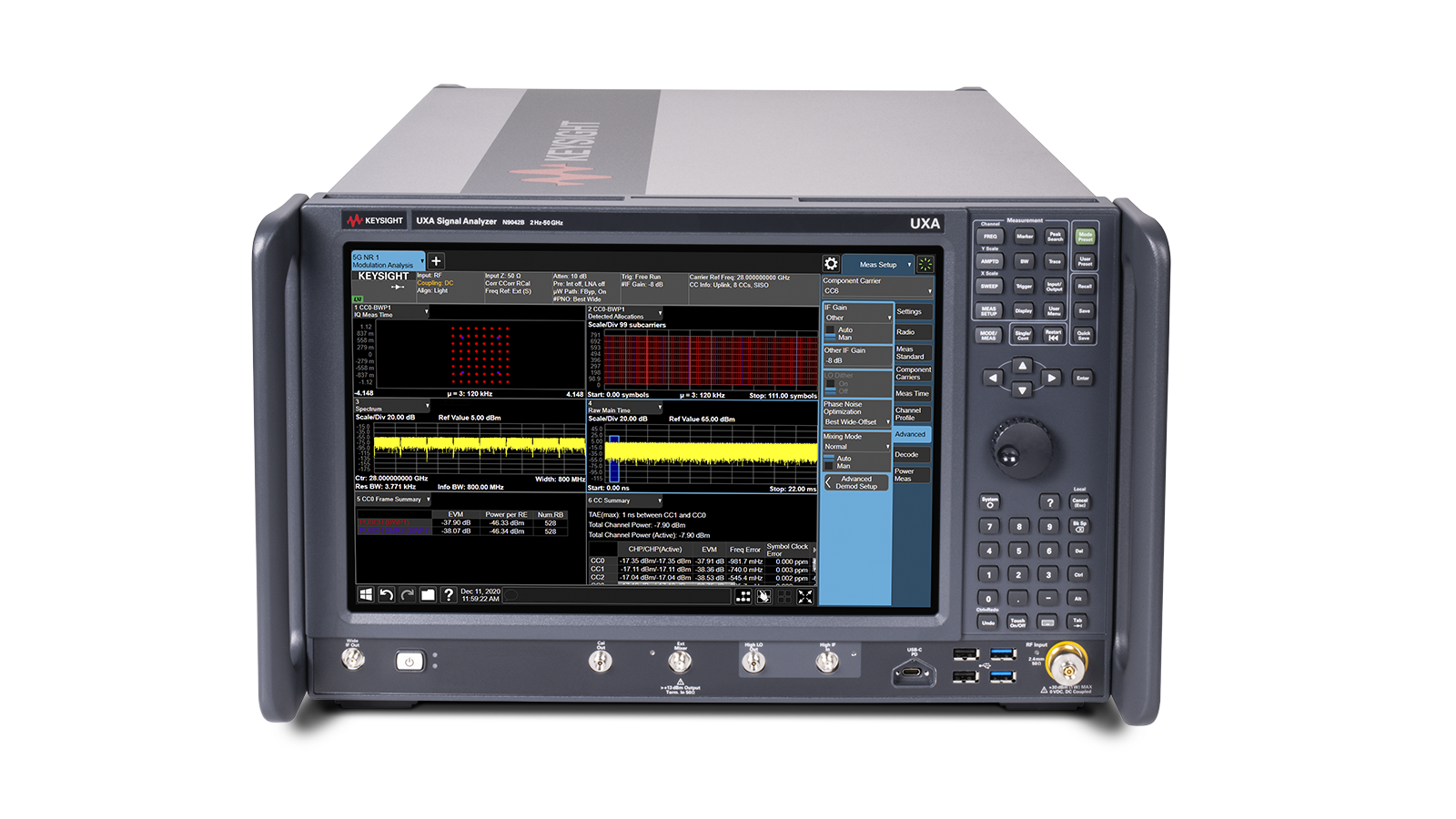





 粤公网安备44030902003758